The Data Residency and Retention Risks Hidden in Consumer AI Tools Professionals Already Use
Sensitive data sent through consumer AI persists longer and travels farther than users realize.
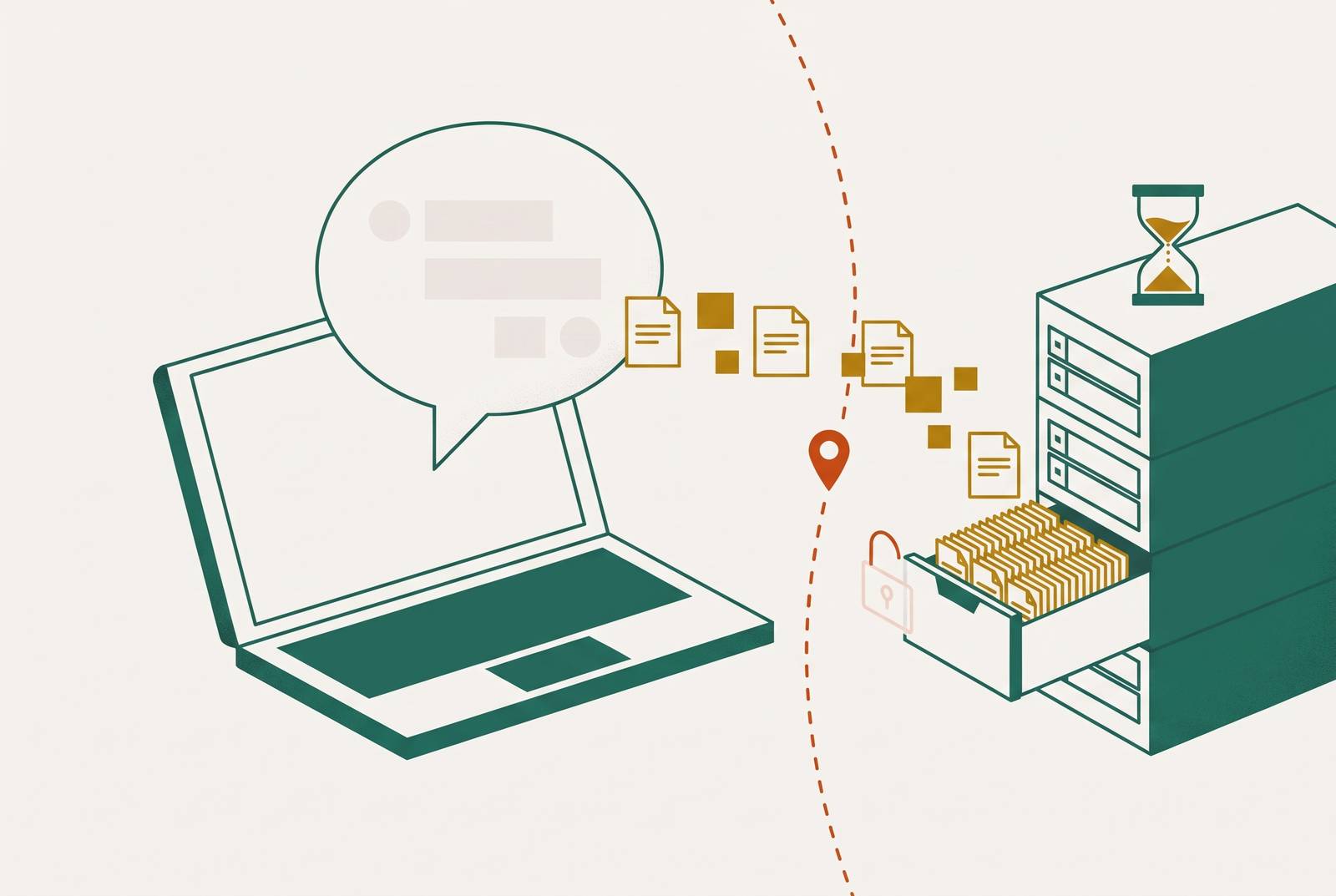
AI tools for privacy-conscious professionals should be judged by where prompts are processed, what gets retained, who can access it, and whether those limits are enforced by architecture. This article examines the hidden data residency and retention risks in consumer AI tools and makes a structural argument. A paid subscription or a no-training promise alone does not establish that sensitive client information stays confidential.
How a single prompt triggers a chain of data operations professionals don't see
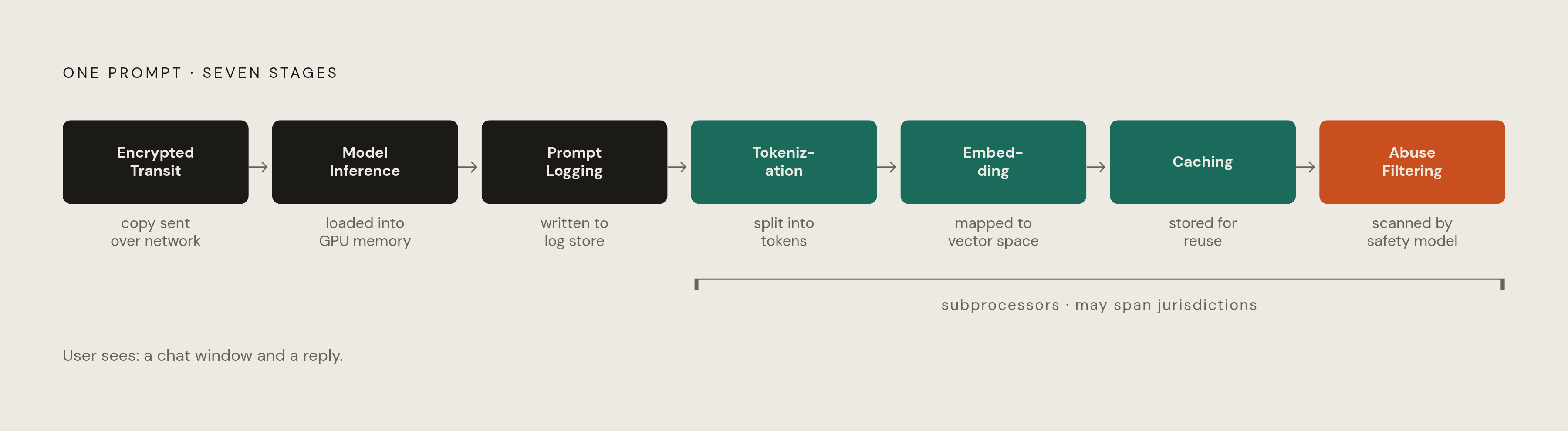
A prompt travels encrypted in transit to a provider’s servers, enters model processing, and becomes part of a log containing the prompt and response. Beyond that log, a document can be tokenized, embedded, cached, and retained for abuse monitoring. Each stage can make another copy or put the data into another form. Those copies may sit in different jurisdictions from the original, even though the professional sees only a chat window and an answer.
Encryption in transit protects one part of this journey. It does not answer what happens after arrival. Nor is this file transfer in the form that IT departments traditionally govern, because information moves as unstructured fragments through several processing stages. Legacy data-loss-prevention tools were not built to see how those fragments move or to enforce limits along the way.
The legal character of the information nevertheless survives the change in format. Pasting a customer record into a prompt does not make it less sensitive than exporting that record. If the inference layer sits in another jurisdiction, the interaction can constitute a cross-border transfer. What the user uploaded and where the resulting processing took place are therefore both relevant.
Why professionals reach for consumer tools rather than waiting for sanctioned ones
Employees generally reach for consumer AI to work faster. Yet their purpose does not alter the pipeline. Consumer and enterprise accounts can use the same URL and chat window, with little on screen to show that a personal session falls outside an organization’s agreement. Personal accounts may also keep personalization or features that the enterprise version lacks, and they take less effort to start using.
That combination makes the behavior difficult to displace. A block-only response can send the same work to personal phones or home machines, where organizational visibility disappears. The data still leaves, but the organization has less ability to understand its destination. Retention must therefore be assessed against the account actually receiving the prompt, rather than the tool the organization believes it has sanctioned.
What retention actually means across the major consumer-tier plans
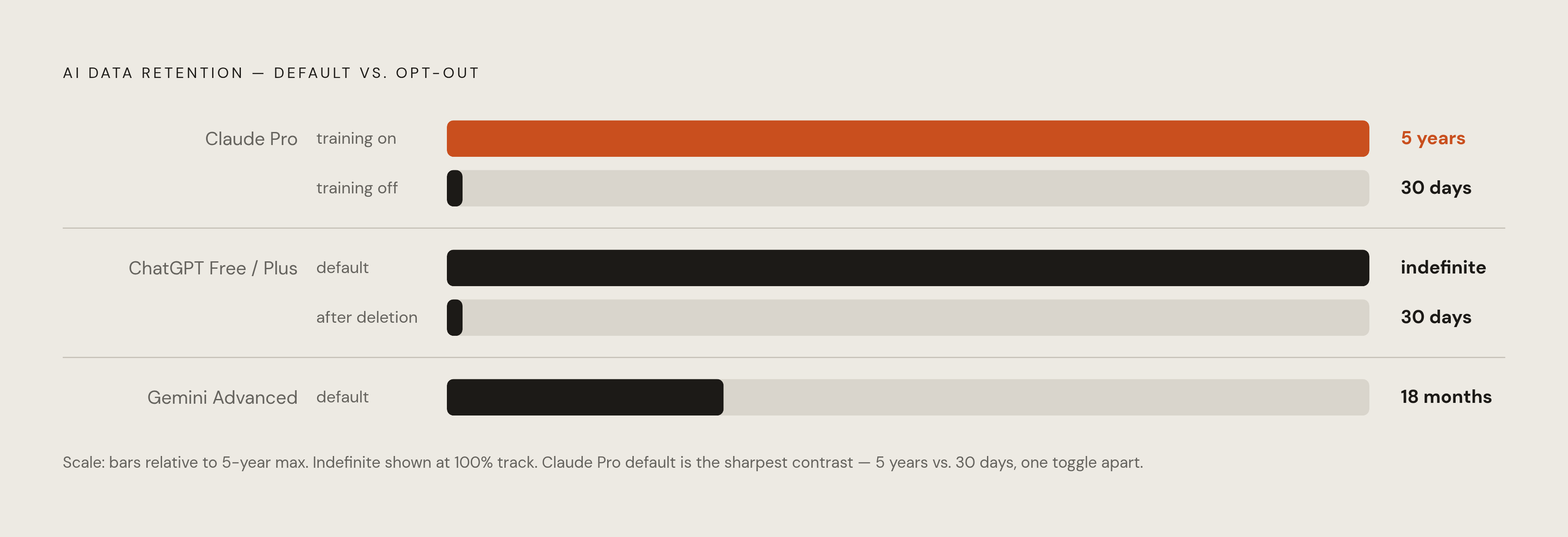
Consumer retention depends on the product, account tier, training choice, and deletion settings, and those policies have changed repeatedly. The policy reference points compiled through early 2026 illustrate that variability. A short rolling period and a multi-year training archive represent different exposures, even when both appear behind a familiar chat interface.
Anthropic’s Claude Pro policy reference point gives up to five years of retention with training enabled by default, reverting to 30-day retention when training is disabled. The company changed its consumer terms in September–October 2025, requiring users to choose between allowing training with up to five years’ retention and opting out with 30-day retention. Users who had not responded by October 8, 2025 had to make a selection before continuing.
OpenAI’s ChatGPT Free and Plus retain conversations until the user deletes them, with deleted chats purged within 30 days and Temporary Chats kept for a limited period. Google’s Gemini Advanced defaults to 18-month retention. All three use infrastructure that includes the US, but none guarantees US-only consumer processing, so knowing how long information remains does not settle where it remains.
Why paying for a higher tier does not automatically close the exposure
ChatGPT Plus and Claude Pro are paid consumer plans, and both train on conversations by default unless the user opts out. The plans identified as contractually prohibiting training on customer content include ChatGPT Team at $30/user/month and Claude Team.
There are consequently different levels of assurance to distinguish. Consumer plans depend on their terms and account settings, while contracted enterprise plans can establish explicit limits on training and retention. Architectural controls address a further question, namely whether the data reaches or persists in the provider’s pipeline at all. These levels are not substitutes for one another.
An enterprise agreement also covers only traffic routed through the enterprise account. Consumer terms still apply to a personal account even when the employer has agreed on stronger protections. When and how often users send requests, and the patterns in their use, can still expose data used for profiling even when an enterprise contract protects prompt content.
How residency promises break inside a modern AI inference stack
Choosing a cloud region usually sets where primary storage sits, but the inference stack goes beyond that storage. Subprocessors in other countries may carry out transcription, safety filtering, and evaluation or provide support tooling. A residency claim is only as strong as that chain. If those stages fall outside the primary vendor’s regional commitment, selecting a region does not establish where the whole interaction occurs.
Three concepts need to remain separate here. Residency is where data is stored and processed, sovereignty is whose legal system governs it, and localization is a legal requirement to keep data within a defined territory. Data stored locally by a foreign-headquartered provider may still be reachable under that provider’s home-country laws.
Remote support engineers who can access production systems bring their jurisdiction into the effective data boundary. GDPR Chapter V also treats an EU user’s prompt to a US-hosted model as a cross-border transfer, even if the original file stays in an EU region. The inference event itself is the transfer. AI systems inherit the obligations attached to the data flowing through them, so an assessment limited to the original file’s location misses the processing that creates the exposure.
What sector-specific obligations make this exposure professionally consequential
For lawyers, retention of client queries can create unauthorized-access or inadvertent-disclosure risks, with consequences for confidentiality duties, malpractice exposure, and disciplinary action. Confidentiality cannot be inferred from a conversational interface. United States v. Heppner established in 2026 that a non-lawyer’s independent use of a public consumer AI tool had no attorney-client privilege or work product protection under those specific circumstances. That ruling makes assumptions about protection especially hazardous.
Healthcare professionals face a different contractual threshold. Sharing patient information with a free public AI tool without a signed business associate agreement can violate HIPAA and put professionals at risk of fines or losing their licenses. General security does not establish specialized compliance. For defense and government contractors, pasting controlled unclassified information into consumer or standard commercial AI almost certainly places it outside an environment meeting DFARS 252.204-7012 and applicable NIST requirements. Defense primes also pass residency and safeguarding obligations down to subcontractors.
Samsung Electronics’ semiconductor division showed how these risks can arise in everyday work. Within weeks after ChatGPT was allowed in March 2023, employees sent it confidential information at least three times. One engineer pasted the full source code for a program that measured equipment, another supplied code that identified equipment linked to yield and defects, and a third entered a transcript of a recorded meeting. These were work requests. Under the default terms at the time, the submissions could be used to train future model iterations.
Samsung first limited prompts to 1,024 bytes, then restricted generative AI on company devices and internal networks from May 1, 2023. It told staff that data sent to external AI servers was hard to retrieve and delete. The company reopened external AI tools under security controls in June 2026. That sequence connects the disclosure mechanism to the harder organizational question of how access can be governed.
Why policy alone does not close the gap between stated rules and actual data flows
A rule against pasting customer data works only if employees spot sensitive content and follow the rule even when a deadline is close. An approved tool does not itself validate the prompt. Even when employees choose the right enterprise account, they can send it information that should never leave the organization. The enforcement gap is therefore not simply a failure to explain the rules clearly.
A professional cannot opt out of tokenization merely by understanding it, or inspect every downstream cache through the chat interface. Technical controls must operate where those actions occur. This calls for enforcement.
Audit obligations make that distinction concrete. The EU AI Act’s Article 12 logging obligation requires high-risk systems to have the technical means for an audit, which written policies alone cannot provide. The Digital Omnibus deferred the originally scheduled August 2, 2026 date to December 2, 2027 for Annex III systems and August 2, 2028 for Annex I systems. Because logs must be kept, a promise to keep nothing leaves some of the organization’s duties unmet. An organization needs to distinguish the records it must keep from the sensitive prompt content it seeks to protect.
What architecture-level controls actually address the residency and retention risk
Zero data retention at the inference layer addresses a different problem from opting out of training. Retention assessments must establish whether prompts are written to disk, cached, or logged at any stage. A training toggle cannot answer that question. Retention protection needs to cover the handling of the prompt throughout processing.
Residency requires an equally complete subprocessor map, including transcription, safety filtering, evaluation, and support access. The map needs to show the location and jurisdiction of every stage. Customer-held encryption keys help close a sovereignty gap because, with provider-held keys, a legal order aimed at the provider can make the data accessible. Key custody is therefore part of the legal boundary.
Truly sovereign AI generally requires some combination of local operation, customer-held keys, and, in the strictest cases, fully self-hosted infrastructure. On-premise or private-cloud inference can eliminate the transfer created when a prompt leaves the organization’s controlled environment. The protection comes from constraining the route itself. Enterprise contracts can allocate liability and define obligations, but they do not by themselves change the data path.
The lesson for tool evaluation is to distinguish contractual restrictions from architectural prevention. A provider’s promise not to use content is different from a design that prevents the content from reaching that provider. Neither a promise nor a design alone proves that every professional duty has been met. The useful standard is whether the system’s design enforces the specific confidentiality, retention, and geographic boundaries the work requires.
How can professionals assess their exposure and choose AI tools for sensitive client information?
A practical assessment starts with the account and its contract. Is the tool operating under consumer terms, paid consumer terms, or a contracted enterprise plan, and does that contract prohibit training, specify retention, and identify subprocessors? The account in use is the relevant evidence.
The next questions concern geography and custody. Where do tokenization, embedding, caching, logging, safety review, and support access occur, and does the same jurisdictional commitment cover each stage? Who holds the encryption keys, and can an order directed at the vendor compel access?
Deletion and inference location complete the assessment. When a user deletes data or a retention period expires, is there an auditable record showing that deletion reached logs, caches, and subprocessor copies? Does the prompt leave the controlled environment during processing, and under which jurisdiction? A disappearing conversation is not, by itself, evidence about every downstream copy.
Professionals need a sanctioned alternative that meets these criteria. The choice is more precise than which assistant seems safest. It is which tool can demonstrate the required limits across the actual data path. Privacy by design makes essential protections structural.