AI Vendor Subprocessor Chains and Third-Party Exposure
Enterprises inheriting hidden vendor chains when deploying AI-powered SaaS.
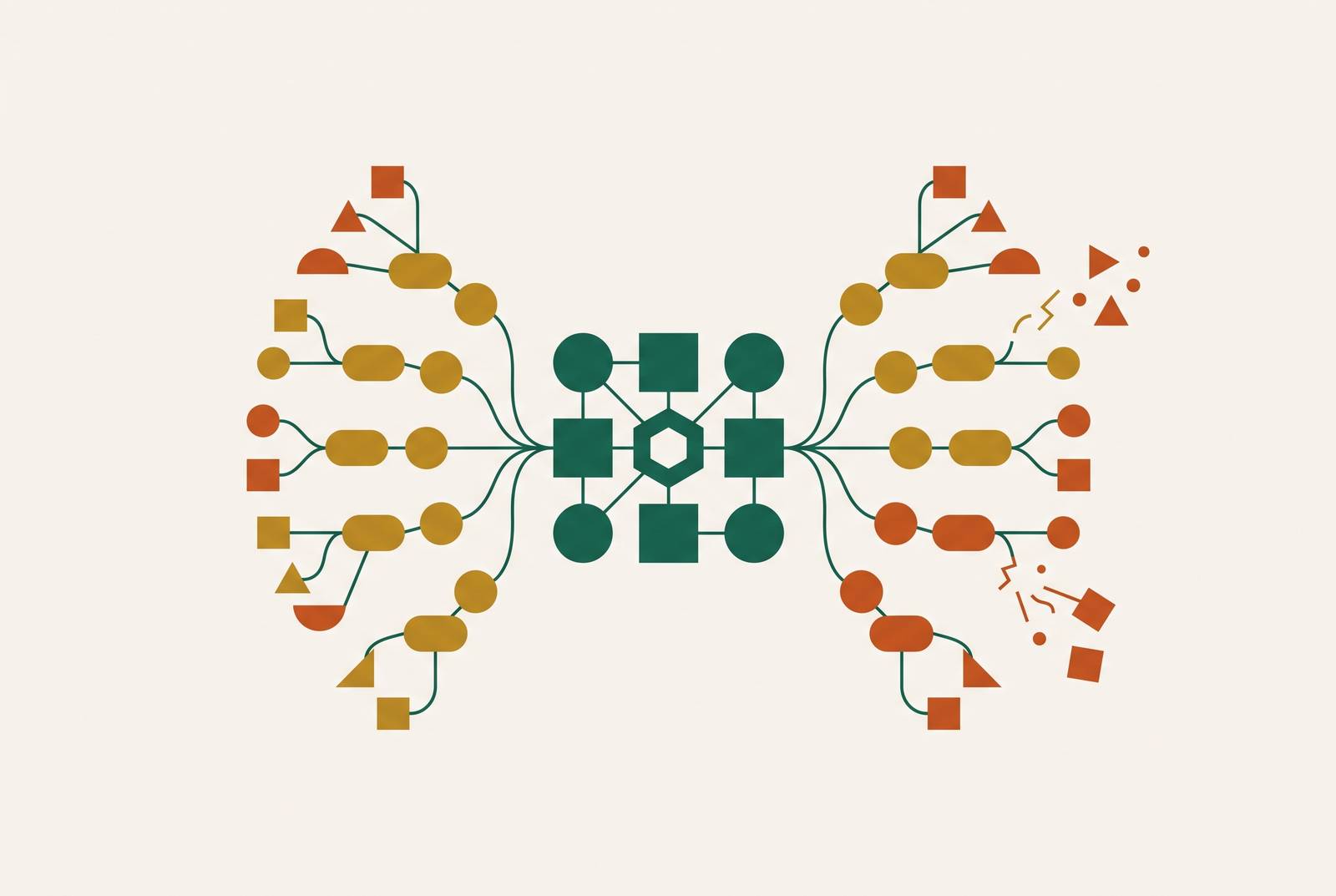
Enterprises that adopt AI-powered SaaS do not inherit one vendor's risk profile. They inherit a layered chain of subprocessors extending into foundation-model APIs, embeddings services, retrieval infrastructure, and safety-filtering systems, most of which no one on the buying side ever reviewed. This piece examines how those chains form, where visibility breaks down, and what due diligence must actually cover to close the gap.
Why buying AI-powered SaaS means inheriting a vendor chain you never reviewed
A procurement team runs real diligence on an AI vendor. Security reviews the questionnaire, legal signs a data processing agreement, and the contract names the subprocessors permitted to touch customer records. The chain beneath it was never static, and the parts that changed were the parts no one was looking at.
The chain is structural, not incidental. Modern AI products are assembled from upstream components the vendor itself does not own or fully control. A foundation-model provider serves the inference, an embeddings service encodes the text, a retrieval system pulls context from somewhere else, and a safety filter screens the output. Each of those components is a separate processor relationship, and each sits behind an API boundary the enterprise can neither inspect nor direct.
Unpack the flow and the scale of the blind spot becomes clear. The subprocessor list, if one was even provided, captures a moment. Nothing captures the chain as it operates.
Traditional software offered a comfort this category does not. A system largely fixed at deployment could be reviewed once and trusted to behave the same way at renewal. The product keeps the same name while its data-handling profile shifts underneath it.
How agentic architectures extend the subprocessor chain beyond what traditional vendor discovery tools surface
Agentic systems take the structural problem and make it dynamic. Each tool call, API invocation, or retrieval action an agent takes on a user's behalf adds another link to the chain that nobody explicitly approved. The chain is not fixed at signing. It is determined at inference time, by whatever the agent decides to call.
Consider the mechanism concretely. By the time the response returns, three downstream vendors have touched the data, and the enterprise approved none of them. Every hop after that is a vendor-risk decision made autonomously by software, and traditional vendor discovery tools have no way to surface what happened.
The attack surface extends beyond data flow. The Miasma supply-chain worm in June 2026 demonstrated the mechanism: malicious content embedded in cloned repositories executed automatically when opened in Claude Code, Gemini CLI, Cursor, or VS Code with AI extensions. The attack vector was the AI tool's file-system access, not the application itself.
OAuth over-privilege amplifies the runtime exposure. A sales intelligence tool requests contacts:write. These grants create standing access that a compromised agent or subprocessor can exploit later, long after the user forgot the permission was ever given. The Vercel incident in April 2026 showed what this looks like in practice. AI assistants built with tighter dependency boundaries and controlled processing environments reduce the number of implicit vendor relationships an agent can create on its own, which is a meaningful architectural distinction when evaluating agentic tools for sensitive deployments.
AI subprocessor sprawl: when the vendor you approved becomes an egress path you didn't
The sharpest version of this problem is not the rogue employee pasting source code into a consumer chatbot. Shadow-AI controls, as most organizations have built them, point at employees adopting unapproved tools. That story is known, and the controls for it exist. The more common threat is subtler and harder to catch: an approved vendor quietly enabling an AI feature that routes production data to a model provider nobody reviewed.
This is AI subprocessor sprawl. It happens when a vendor adds a new AI model provider to the chain without telling the customer in a way that lands, and the model behind the feature becomes a subprocessor of customer data the instant the feature toggle flips. The software approved at procurement is no longer the software running, and nothing in the process flagged the change.
The exposure hides inside tools that already passed the last security review. CRM, helpdesk, marketing, HR, and accounting platforms are the natural hosts for these features, precisely because they hold the data an AI feature wants to process. Because the application already passed review, the new AI capability often ships without triggering a new approval workflow. The vendor's AI becomes the enterprise's shadow AI, sitting behind a logo the buyer already trusts, inside a contract already signed, under a feature nobody asked for.
The consequences are not limited to model-provider exposure. The vendor chain, once again, carried the risk that the contract review never surfaced. Architectures that keep inference and processing local, where the service operator cannot route user prompts to external vendors without explicit approval, close that egress vector by design.
Where contractual visibility actually breaks down across the subprocessor chain
Enterprises that have done the contractual basics still face a visibility gap. A DPA exists. A subprocessor list was reviewed. But those lists reflect the chain at a point in time, and the notification mechanisms meant to close the gap are structurally weighted against buyers. The burden falls on the buyer to notice what has changed, while the vendor holds the information.
Model providers make this worse. A model can be retrained, fine-tuned, or swapped for a newer version with no meaningful notice to downstream customers. A model that passed evaluation in January can drift by June because the underlying architecture, weights, or training pipeline were updated behind an API that looks identical from the outside. The contract is unchanged, and the behavior is not.
Training-data provenance is a parallel failure. That is a non-answer with real consequences. The deployer inherits a compliance problem it did not create and cannot inspect.
The AI-specific framing matters here. An organization can be fully compliant with traditional software supply chain frameworks like SBOM and still have no visibility into its AI supply chain. None of those frameworks were built to track a model's training data, its provenance, or its behavior after deployment. They describe a world where the artifact is fixed at build time, which is precisely the assumption AI vendors violate.
The compliance obligations that the subprocessor chain triggers, and the gaps that survive even careful DPA work
A subprocessor chain without visibility is not merely a security problem. It is simultaneously a GDPR Article 28 failure, a potential EU AI Act Article 25 reclassification, a post-Schrems II transfer deficiency, and, for healthcare and financial services, a sector-specific violation that no general DPA resolves. The obligations trigger across multiple frameworks at once, and each gap in the chain produces a corresponding compliance gap.
GDPR Article 28 requires a written DPA with every AI vendor that processes personal data on the deployer's behalf, including those receiving names, email addresses, or identifiable information through user prompts. The right-to-erasure problem compounds it, because AI systems embed data into model weights rather than queryable records. Technical erasure becomes complicated in ways the GDPR's Article 17 framework did not anticipate, and a deletion request that is straightforward in a database is not straightforward inside a trained model.
The EU AI Act adds another layer. Article 25, enforceable from December 2, 2027, converts any organization deploying a third-party AI system under its own name or brand into a full AI provider with conformity assessment, technical documentation, and registration obligations. Most enterprises have not modeled what that reclassification means for the subprocessor chains they have already deployed. For EU companies routing personal data through US-based AI providers, most Transfer Impact Assessments have not been conducted, making those transfers legally deficient under post-Schrems II requirements.
Sector-specific obligations stack on top. Healthcare organizations require both a HIPAA Business Associate Agreement and a GDPR Article 28 DPA for AI vendors receiving patient data. Neither alone satisfies the other, and both are required where EU and US patient data coexist. The U.S. Treasury's FS AI RMF, issued February 19, 2026, covers AI risks throughout the supply chain and contemplates fourth-party disclosure and termination rights. The liability consequence is direct: when a vendor's AI feature quietly violates a deployer's own customer-facing data promises, the liability sits with the deployer.
Why the standard contractual governance model is not enough on its own
The objection is reasonable. An enterprise has DPAs, notification clauses, and objection rights. Those are real controls and they should be in place. The argument is not that they are worthless. It is that they function as compliance theater when the enterprise has no independent ability to detect what the chain is actually doing between reviews.
The standard structure sounds protective: thirty days of notice, fourteen days to object, silence treated as approval. In practice it places the burden of active monitoring on buyers who lack visibility. Most organizations do not have a mechanism to detect when a notification has arrived, let alone to evaluate it within the window. The notice period assumes a buyer who is watching, and the whole problem is that no one can watch.
Point-in-time questionnaires carry the same structural weakness. The annual cadence was built for software that behaves the same way at renewal as it did at signing. A well-documented 2023 incident involving Samsung engineers using ChatGPT to debug proprietary semiconductor code, where inputs were potentially eligible to become training data under the terms of service at the time, illustrates the gap between policy and practice. GDPR compliance that covers Article 28 DPAs but ignores the subprocessor chain is compliance theater, because the chain is the gap that survives even when a company believes it has done enough on the basics. The technical dissent goes further. Privacy-preserving AI architectures, designed from the ground up to keep data from flowing to external model providers or third-party services, offer a structural alternative to the default chain-of-custody model most AI vendors rely on, and Confidant AI's controlled-environment approach is one implementation of that principle.
What a working AI subprocessor audit actually covers
Closing the visibility gap starts with an AI-specific vendor inventory. The enterprise needs to know who has access to what, and which vendors process its data with AI or subprocessors. That means identifying not just contracted vendors but every AI feature toggle that may have been enabled since the last review. The inventory is not a renewal artifact. It is a living record of the chain as it currently operates.
Treat every vendor AI feature toggle as a subprocessor change rather than a product update, because legally and practically that is what it is. The model behind the feature becomes a subprocessor of customer data the instant the toggle flips. That reframing forces the right questions. It must establish whether the enterprise can opt out of AI features where needed. It must enumerate which OAuth scopes the tool requests and which are required versus optional for the documented feature set.
OAuth hygiene becomes a standing control rather than an incident-response activity. The review then tiers by risk: not every supplier needs the same depth, but every AI feature toggle in a high-tier vendor with access to sensitive or regulated data should trigger an equivalent review to a new subprocessor onboarding. Continuous monitoring is the operational baseline, because a vendor whose posture looked acceptable at the annual review can change materially the next month.
What to require in contracts to make subprocessor obligations enforceable, not aspirational
A contract that does not explicitly address AI features, subprocessor chains, training-data use, and agentic tool permissions leaves the enterprise with obligations it cannot enforce when the chain changes. The subprocessor disclosure clause must cover AI model providers, not just infrastructure vendors, with a current list and data residency for each. A contractual notification period of at least thirty days before new subprocessors are added gives the buyer a window in which to assess rather than absorb.
The right to object to subprocessor changes must carry a meaningful termination right if the objection is not resolved. Incident notification requires a twenty-four-hour window from the vendor becoming aware of any security event affecting customer data, with content requirements specifying affected data categories, volume, affected customers, and remediation steps. For healthcare contexts, the review surfaces whether both a BAA and a GDPR Article 28 DPA are required before signing. A vendor that refuses these clauses is sending a risk signal worth taking seriously.
The architectural alternative: designing so personal data does not enter the subprocessor chain
Contractual and audit controls govern a chain the enterprise cannot fully see or stop. The architectural alternative is to design AI workflows so that personal data never enters the subprocessor chain at all, eliminating the exposure rather than managing it after the fact. Pre-prompt anonymization or data minimization at the enterprise boundary means what reaches the model API contains no personal data subject to GDPR, HIPAA, or sector-specific obligations. The subprocessor chain still exists, but the enterprise's exposure through it is structurally reduced.
This is not an either/or with contractual governance. An enterprise still needs DPAs, subprocessor lists, and audit rights. The architectural approach closes the residual gap those controls leave open, the chain that forms at runtime in ways nobody anticipated at signing. The practical question for vendor selection with sensitive data is therefore not only what the DPA says but what the architecture guarantees. A system where data does not reach third-party infrastructure by design provides a different risk profile than one where it does, regardless of what the contract promises. The decision facing enterprise teams is the one this piece has been building toward: govern the chain, or reduce what the chain can reach.