Samsung Confidential Source Code ChatGPT Leak Post-Mortem
Technical controls, not training alone, stop sensitive data from reaching AI services.
Samsung's 2023 ChatGPT leak is usually told as a story about careless engineers. It was actually a story about missing infrastructure: a company that makes some of the most advanced semiconductors on earth let its staff hand proprietary data to an external server with no technical control standing in the way. Three incidents made that failure visible, and all three still shape how enterprises think about AI governance.
Samsung's semiconductor source code ending up on OpenAI's servers
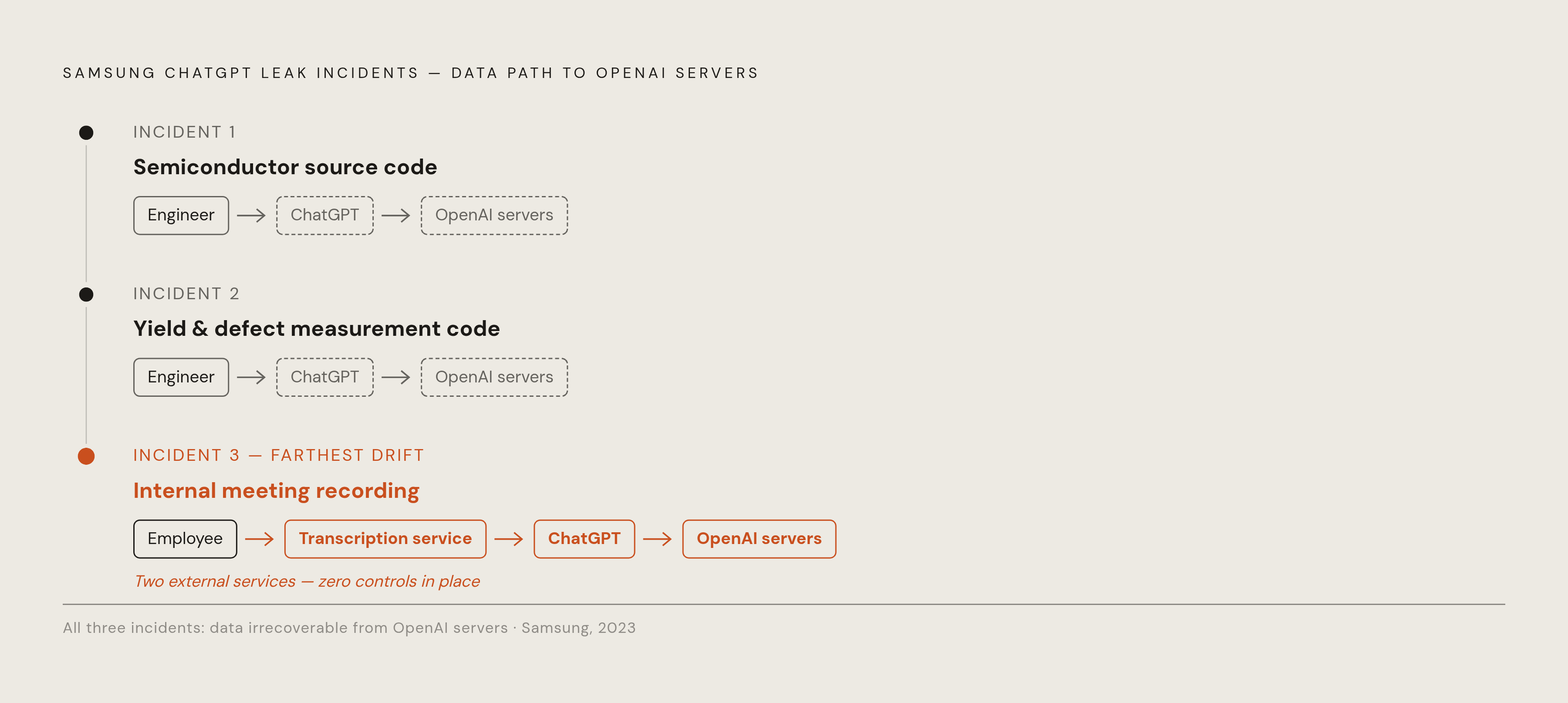
Start with the third incident, because it shows how far the leak path had already drifted from a simple copy-paste mistake. An employee recorded an internal meeting, ran the audio through a third-party transcription service to turn it into text, and then fed the full transcript into ChatGPT to generate meeting minutes. That is two external services handling Samsung's internal deliberations, not one, and the strategic content of that meeting passed through both before anyone at Samsung registered a problem.
The other two incidents were more direct but no less serious. In one case, an engineer submitted actual semiconductor source code to ChatGPT and asked for help fixing errors. In another, a separate engineer submitted code tied to yield and defect measurement for semiconductor manufacturing equipment, again asking for optimization help. Yield data tells you how a fab is performing right now and how far it is from its theoretical ceiling, which is exactly the kind of information a competitor would pay to get its hands on. South Korean outlet Economist Korea first reported all three incidents, and Samsung confirmed them afterward.
None of the three employees set out to leak anything. Each was trying to get a task done faster: fix a bug, optimize a process, turn a meeting into usable notes. That detail matters for the whole piece. A story about three careless or malicious insiders would point toward a training fix. A story about three well-intentioned employees hitting zero technical resistance points somewhere else entirely, toward the absence of any system built to catch them before the data left the building.
Why the data could not be retrieved once submitted
Samsung's internal memo on the incidents stated the problem in plain terms: "As soon as content is entered into ChatGPT, data is transmitted and stored to an external server, making it impossible for the company to retrieve it." That sentence describes a technical fact, not a legal posture. Once the text crosses the wire to OpenAI's infrastructure, Samsung has no further say over where it sits or who can query against it.
At the time of the incidents, OpenAI's default settings made user conversations eligible for use in model training unless a user opted out through an in-app control, found under Settings, then Data Controls, then an option called "Improve the model for everyone." That control existed, but it was not surfaced in a way a busy engineer solving a deadline problem was likely to notice or use. OpenAI's own user guide warned people against submitting sensitive information and said submitted text could become training data absent an opt-out. The warning was there in writing. But nothing in the product stopped a paste action from going through anyway.
Research on model memorization has shown that large language models can memorize and later reproduce specific fragments of their training data, a smaller but real risk sitting behind that one. That means Samsung's submitted code could, in principle, surface in a response given to a completely different user asking about semiconductor diagnostics. The odds of any single fragment being extracted verbatim are low. For a company whose entire competitive position rests on manufacturing process secrets, low is not the same as acceptable. OpenAI has since tightened its terms and added clearer retention and opt-out controls, but those changes arrived after Samsung's data had already left its hands.
The governance decisions that left no barrier between proprietary code and a cloud service
Samsung's Device Solutions division approved ChatGPT use on March 11, 2023. That approval came without a formal registry of what AI tools were in use anywhere in the organization, without any access control framework specifying what categories of data employees could or could not submit, and without a single technical enforcement point at the endpoint, the network, or the browser. The policy was permission. There was no mechanism behind it.
The consequences of that gap compounded. There was no shadow AI detection in place, no data loss prevention tooling tuned to catch submissions headed toward an AI chat interface, and no audit trail logging what had gone out to external AI services. When the three incidents came to light, Samsung's own security teams could not fully reconstruct everything that had already been exposed, because nothing had been built to record it.
Standard DLP tools would not have caught any of this on their own. Those systems were built to watch for file transfers, email attachments, and upload activity, not for text pasted into a browser-based chat window. AI submission is its own channel, and it needs controls built for that channel specifically. Had a DLP system tuned for AI submissions been watching during the first incident, it could have flagged the source code pattern and blocked the text before a single character reached OpenAI's servers. Because no such system existed, the second and third incidents proceeded with no warning behind them at all; each happened in total isolation from the one before it.
One objection comes up constantly around this case: the engineers knew ChatGPT was an external tool, so why isn't this simply a training failure, a matter of employees who should have known better? A rule with no technical enforcement behind it is a suggestion, not a control. Asking employees to remember a policy under deadline pressure, with no system checking their work, is a plan that fails on a predictable schedule. Policy documents who is responsible after something goes wrong. It does nothing to stop the data in transit, which is the only moment that actually matters.
Samsung's immediate response and its first, nearly unusable fix
Samsung moved fast once the incidents surfaced. ChatGPT access was blocked across Samsung's networks as soon as internal security became aware of what had happened, and the company opened an internal investigation. That investigation reportedly concluded the three known incidents were probably not isolated, that broader usage patterns pointed to additional leakage events nobody had caught.
Before the full block went into effect, Samsung tried a narrower fix: a tight byte-level cap on how long a ChatGPT prompt could be. The intent was reasonable, limit how much proprietary material could fit into a single submission. The effect was closer to disabling the tool for its most useful purpose. Meaningful code review or debugging requires enough context to show the function in question, its dependencies, and the error it's producing. A byte cap tight enough to stop someone from pasting in a module of source code is also tight enough to stop someone from pasting in a legitimate, harmless snippet for routine debugging help. Samsung built a control that could not distinguish a module of proprietary source code from a harmless debugging snippet, so it blocked both.
Alongside the technical measures came mandatory AI usage training and new written guidelines on what categories of information could go to external tools and what could not. Those were reasonable steps, but they were written after the fact, under emergency conditions, to patch a hole that had already been exploited three times.
None of this addressed the underlying demand. Employees wanted help writing code, debugging it, and summarizing meetings, and that need did not disappear when the network block went up. Banning a tool without giving people a sanctioned alternative tends to push the same behavior onto personal devices and personal accounts, somewhere the organization has no visibility whatsoever. A ban that drives usage underground does not reduce risk; it makes the risk invisible, arguably worse than the problem Samsung was trying to solve.
Why a total ban is an unstable equilibrium
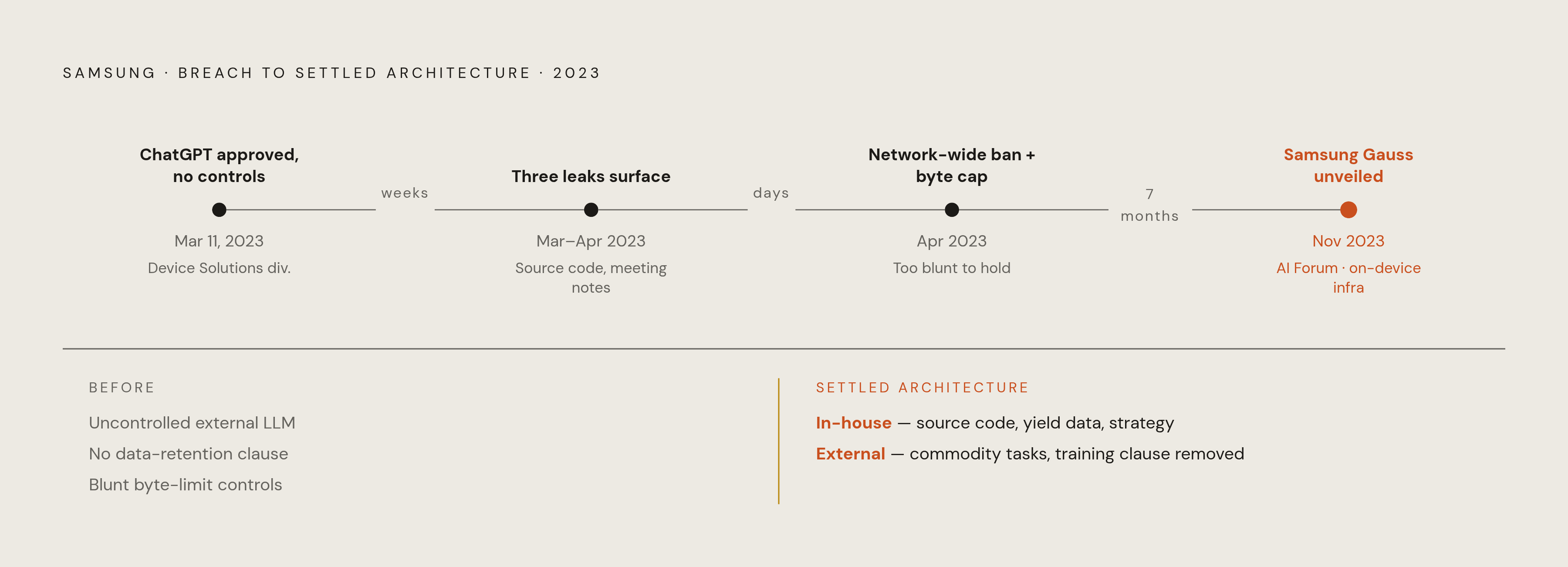
Samsung's own trajectory after the ban is the clearest evidence that prohibition alone does not hold. Seven months after blocking ChatGPT, at the Samsung AI Forum in November 2023, Samsung unveiled Samsung Gauss, a generative AI system built on models running inside Samsung's own infrastructure. A company that had just banned external AI for its engineers came back seven months later with its own version of the same capability, run on hardware it controlled.
Samsung Gauss shipped as three components: Samsung Gauss Language, Samsung Gauss Code, and Samsung Gauss Image, covering more or less the same tasks, language assistance, coding help, image generation, that had sent employees to ChatGPT. Samsung also set up an AI Red Team to run adversarial testing against its AI models, so it could catch safety threats before they reached production use.
Samsung Gauss was genuinely useful, but it could not match frontier external models on general-purpose productivity tasks. That gap cuts against a simple read of this story: if the lesson were "build everything in-house and the problem goes away," Samsung's experience complicates it, since a self-hosted system built from scratch struggles to keep pace with models that external labs are iterating on at a much larger scale. The answer Samsung arrived at splits the difference. Sensitive data, source code, yield figures, strategic deliberations, stays inside infrastructure Samsung controls. Lower-stakes, commodity tasks can run on external models, but only under a contract structured to remove the default training-data clause that caused the original leak.
That second track brings its own limits: an enterprise contract like ChatGPT Enterprise removes the specific channel where submitted data becomes training data for that product. But it does nothing to stop an employee from opening a personal ChatGPT account on a personal phone, installing an unapproved browser extension that routes text through its own AI backend, or adopting some new AI tool that launches next month outside whatever list Samsung has approved. A contract closes one door. It is one layer in a larger system, not the system itself.
How the incident spread across the industry
Samsung's leak did not stay Samsung's problem. Companies across the industry restricted ChatGPT use in the months that followed, and most of them repeated Samsung's original mistake in reverse order: Samsung built no architecture, then reacted with restriction; these companies skipped straight to restriction without ever building the architecture either.
Amazon had already found examples of ChatGPT output that closely resembled Amazon's own internal data before it formally restricted employee use of the tool, a sign that the exposure Samsung experienced was not a one-off tied to its particular workflow or its particular engineers. The pattern across companies was consistent: discover the risk after it had already materialized, then respond with a restriction rather than with a system designed to prevent the next version of it.
That pattern says less about any individual company's judgment than about the state of enterprise AI governance generally. A large share of knowledge workers across industries were already using AI tools for real work by the time these incidents surfaced, while only a small fraction of the organizations employing them had any formal controls in place to manage that usage. Samsung's leak was not a strange exception sitting apart from an otherwise well-governed landscape. It was one visible sample pulled from a condition that was already present almost everywhere.
What the regulatory environment adds to the structural pressure
The legal backdrop to all of this has only gotten heavier since 2023. Data protection authorities in France, Germany, and Spain have opened their own investigations into how ChatGPT handles user data, and those investigations sit on top of whatever contractual or reputational risk a company like Samsung was already managing on its own.
The regulatory angle traces back to the same technical property that made Samsung's leak irreversible. Data submitted to an external server with no deletion mechanism is precisely what regulators examining GDPR compliance are now scrutinizing. Samsung's internal concern about GDPR exposure after the incidents turns out to have anticipated where the regulatory conversation was headed. An organization that still has no AI data-governance architecture in place today is carrying both the IP risk Samsung carried in 2023 and a live compliance exposure that did not fully exist in the same form back then.
A further risk is building on the horizon that deserves attention before closing this out. Newer ChatGPT-style tools connect directly to email, calendars, and cloud storage, which widens the attack surface well past anything a copy-paste action could reach. Prompt injection attacks combined with those external connectors can create a path for data to leave an organization without any human deliberately pasting anything. The Samsung case was identifiable precisely because three employees made three visible choices to submit specific pieces of content. The next generation of incidents may not leave that kind of trace, because the action that exposes the data might not require a person to decide to do it.
What architecture keeps proprietary data from leaving the building
Every failure traced through this piece collapses to one root condition: the moment an engineer pressed submit on ChatGPT, that data was on OpenAI's infrastructure, governed by OpenAI's terms, outside Samsung's reach. No policy written afterward, no training module, no DLP tool bolted on after the fact, can undo a transfer that has already happened. Everything downstream of that moment is damage control.
An architecture where the model itself runs inside the organization's own infrastructure eliminates that condition at the source. Code pasted into a model running locally goes from the editor into that model's memory and nowhere else. No network request carries it off the premises. No cloud service receives a copy. The conversation exists only on hardware the organization already owns and controls. There is no external server for a regulator to investigate and no training pipeline for a fragment of that code to resurface from later.
Samsung's own trajectory after the incident amounts to this conclusion stated through action rather than words: the only way to use AI safely on confidential material is to run that AI on infrastructure the organization controls. Samsung Gauss was the first attempt at that answer, and the two-track model the company settled into afterward, in-house infrastructure for sensitive work, contracted external models for commodity tasks, is the fuller version of the same idea.
Privacy has to be designed into an AI system from its first architectural decision, not added later through a contract clause or a usage policy. An enterprise agreement removes the training-data channel for one specific product. It leaves standing the more basic fact that the data is still leaving the organization's control and sitting on someone else's server. For a company holding sensitive intellectual property, regulated personal data, or confidential internal communications, the real question is whether the AI system in question can run so that the data never has to leave the organization's own control.
Samsung's post-mortem leaves behind a short, practical checklist for any organization watching from the outside. Set a data-governance boundary before any AI tool is approved for use, not after the first incident forces the question. Use DLP controls built specifically to inspect and block AI submissions at the content level, since tools designed for email and file transfer were never built to see this channel. And before restricting a tool employees have already found useful, give them a governed alternative, because a ban with nothing behind it simply moves the same risk onto personal devices where no one is watching it anymore.