FedRAMP Authorization Requirements for AI Services
New framework replaces narrative paperwork with continuous automated security validation.
FedRAMP authorization for AI services no longer runs through the same process that cloud vendors used for the past decade. A new framework called FedRAMP 20x, a 2026 rules overhaul, and a set of AI-specific technical requirements now define what it takes to sell AI to federal agencies, and the vocabulary itself has changed enough that outdated marketing language can sink a proposal before a contracting officer even reads the technical details.
What FedRAMP 20x is and why it replaced the legacy process
The old FedRAMP process, running since 2011, asked vendors to write. A lot. Documentation packages walked through hundreds of NIST 800-53 controls in narrative form, describing policies and procedures rather than proving anything was actually happening in production. Industry estimates put the cost of getting through that process at around $250,000 for a Low impact system, $350,000 for Moderate, and up to $1 million for High, with agency approval timelines routinely running 12 to 15 months. GSA has been blunt about the consequence: the FedRAMP Marketplace grew too slowly to keep pace with agency demand, and the agency has described the old process as holding the government back from the modernization it needed.
GSA announced the fix, FedRAMP 20x, on March 24, 2025. The idea is cloud-native authorization built around continuous, automated validation of security outcomes instead of static paperwork. That's a real inversion in how assessment works. Under the legacy Rev5 process, an assessor asks a vendor to describe how it enforces multi-factor authentication. Under 20x, the question becomes a demand for telemetry: show, right now, that MFA is enforced for 100 percent of privileged users. One is a story. The other is a live feed.
FedRAMP tested this in two pilots. Phase 1 ran at the Low impact level between April and September 2025, with 10 vendors selected. Phase 2 moved to Moderate, running from November 18, 2025 through the end of March 2026, limited to vendors that passed Phase 1, AI-prioritized offerings, and services flagged as critical-need. FedRAMP received 14 qualifying submissions in that round and granted 8 Moderate pilot authorizations. Each participant got roughly 5 to 6 hours of direct time with FedRAMP leadership, working through the philosophy behind Key Security Indicators, which says something about how different this mental model is from what vendors were used to.
According to FedRAMP's Nicole Thompson, speaking at the Risk & Compliance Exchange, feedback from agencies, cloud providers, and third-party assessors converged on the same conclusion: the 20x packages held more useful data than the old 800-53 control lists, organized in a format people could actually navigate. The pilot also killed off a specific piece of friction that vendors complained about for years, the significant change request process, which used to require government sign-off before a vendor could update its own commercial product. That approval gate is gone under 20x.
The Consolidated Rules for 2026 and the transition timeline every vendor must track
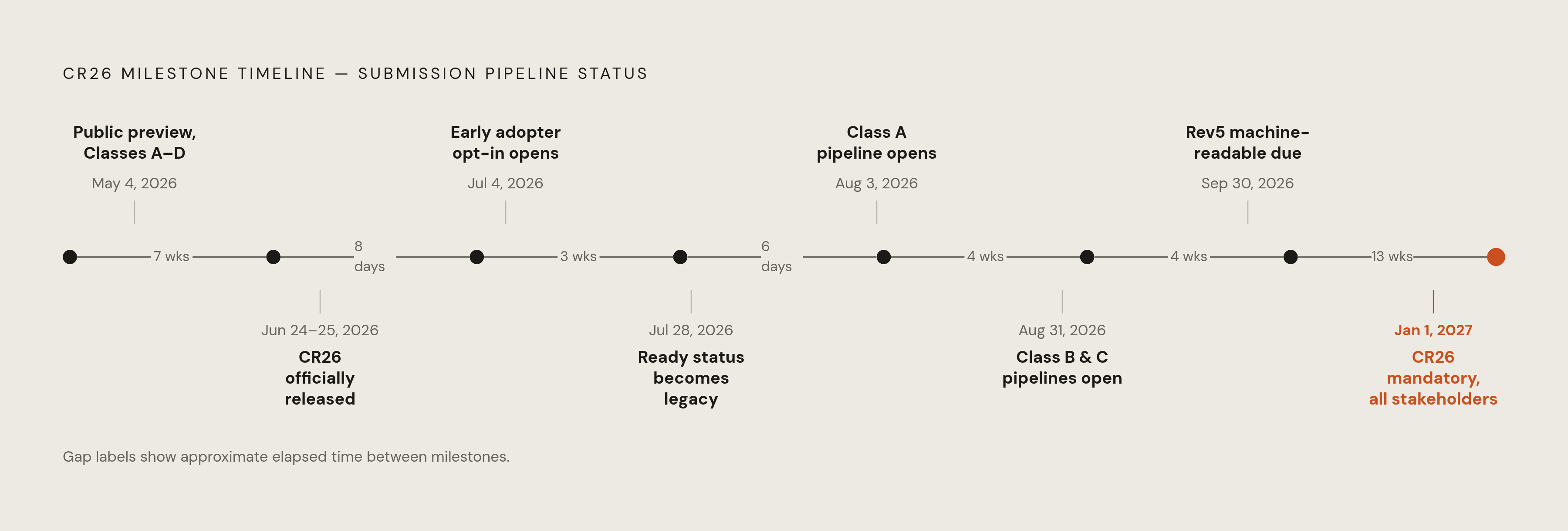
FedRAMP finalized what it calls the Consolidated Rules for 2026, or CR26, releasing the ruleset on June 24, 2026 and announcing it officially the following day. CR26 is a single rulebook covering cloud providers, third-party assessors, and agencies, and it ships with machine-readable JSON schemas built on the assumption that certification packages get updated continuously through automation, not refreshed once a year before an audit.
The dates matter here, and vendors that lose track of them risk submitting into a pipeline that no longer exists. Public preview of CR26 launched May 4, 2026, and that's the moment the terminology shifted: "authorization" became "certification," and impact levels turned into Classes A through D. Those changes became official with the June 24-25 release. Early adopters could opt into CR26 starting July 4, 2026. FedRAMP Ready became a legacy designation on July 28, 2026, with no new Ready submissions accepted after that date. The Class A pipeline opened August 3, 2026, and Class B and Class C pipelines followed on August 31, 2026.
A few more dates round out the runway. RFC-0024 requires Rev5 certification holders to produce machine-readable packages by September 30, 2026. CR26 becomes mandatory for every stakeholder on January 1, 2027. The Rev5 legacy framework itself doesn't disappear until June 11, 2027, giving late movers a cushion, though FedRAMP has said that CR26 is "the central reference point" now, and Rev5 holders shouldn't wait around to learn the new rules. Parenthetical impact-level labels, kept alongside the new class names to ease the transition, disappear entirely after December 31, 2026. A Class D pilot, covering the old High impact level, is planned for FY2027 Q1 or Q2, though that piece of the framework isn't built yet.
CR26 also opens up two distinct roads to certification. The Program path lets a vendor submit directly to FedRAMP, which removes what was historically the single biggest barrier standing between a startup and the federal market. The Agency path keeps a federal sponsor in the loop, and it remains the only route available for Class D. FedRAMP says it beat its own FY25 target for new authorizations, adding 124 cloud services to the Marketplace, which the agency points to as proof the 20x approach is actually moving faster, not just differently.
How the new Certification Classes map to AI workloads
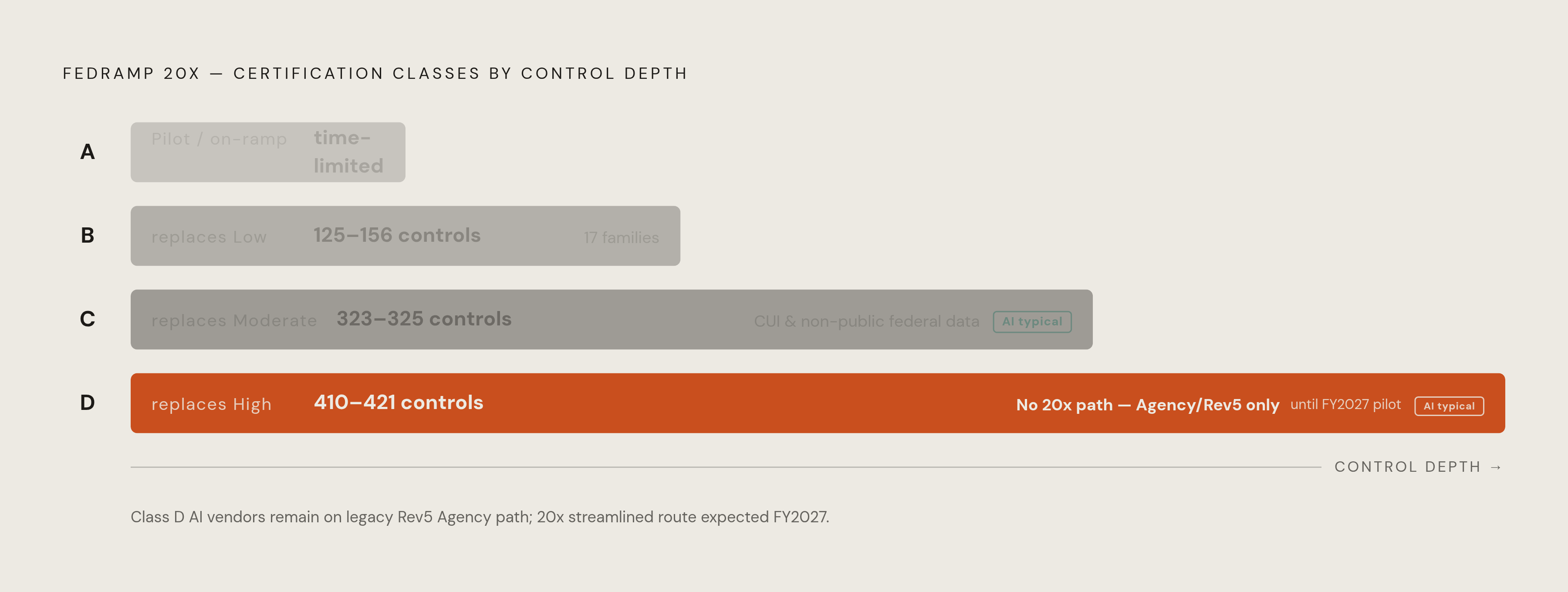
Why drop "Low, Moderate, High"? Because those FIPS 199 labels collided with the Department of Defense's Impact Level system (IL2 through IL6) and and the overlap created real confusion in procurement documents and security paperwork alike. Alphabetical classes sidestep the naming collision, but a Class describes the depth, frequency, and quality of the certification data a vendor produces, not a direct statement about how sensitive an agency's data is.
Four classes now exist. Essentially a pilot lane, Class A is a time-limited on-ramp. Class B replaces Low and covers roughly 125 to 156 controls spread across 17 control families. Class C replaces Moderate and applies to systems handling Controlled Unclassified Information or other non-public federal data where a breach would cause serious, but not catastrophic, harm; it runs about 323 to 325 controls. Class D replaces High, built for mission-critical federal systems where a breach could be severe or catastrophic, and it carries somewhere between 410 and 421 controls. Both B and C pipelines opened August 31, 2026. Class D has no 20x pathway yet, so any vendor targeting it has to go through the Agency path under the older Rev5 framework until the pilot arrives.
So where does AI actually land? Most AI platforms end up needing Class C or Class D, depending on what they touch. A model processing CUI, law enforcement records, financial or health data, or anything tied to critical infrastructure is generally headed toward Class D. Conversational AI tools built for routine federal workforce use, which is what FedRAMP's AI prioritization program targeted, are generally expected to meet at least Class C requirements.
That split creates a real planning problem for vendors chasing Class D: the 20x Program path simply isn't available to them yet. They need an agency sponsor and have to work through the legacy Rev5 Agency path until the Class D pilot opens sometime in FY2027.
Key Security Indicators, what replaces NIST 800-53 narrative controls in the 20x path
Key Security Indicators, or KSIs, take the place of the long narrative control descriptions that defined Rev5 packages. Instead of writing paragraphs explaining a security practice, vendors now have to produce measurable, automatable evidence that gets validated continuously, not once at assessment time and then filed away. RFC-0006 sets 56 KSIs for the Low-equivalent tier; RFC-0014 sets 61 for the Moderate-equivalent tier. Both sets are organized across a set of themes covering identity, system protection, cloud-native architecture, monitoring and logging, incident response, vulnerability management, data protection, and supply chain security.
CSPs must persistently validate, persistently review, persistently monitor, a word that appears constantly across the KSI documentation. CSPs must persistently validate, persistently review, persistently monitor. Security posture has to be verifiable straight from the production environment, in real time, rather than reconstructed after the fact from a compliance binder. Going back to the MFA example: Rev5 wants a written description of the enforcement policy. The 20x KSI wants telemetry, live, showing 100 percent of privileged users actually under MFA enforcement right now, this minute.
What does that mean day to day for an AI vendor? Evidence collection has to be automated and continuous, not something the compliance team assembles every quarter. Security instrumentation needs to be built into the production environment from the start, not bolted on right before an assessor shows up. The fact that each moderate pilot participant received roughly 5 to 6 hours of dedicated time with FedRAMP leadership tells you the mental shift here isn't cosmetic. Vendors used to writing about security had to relearn how to instrument it.
The payoff for that adjustment is speed. The pilots cut authorization timelines dramatically compared to the 12-to-15-month agency approval timelines typical under Rev5, a reduction that represents the core pitch behind the 20x name. That's the entire pitch behind 20x in one number.
AI-specific technical requirements layered on top of the standard control baseline
Meeting the standard control baseline for a Class C or Class D certification is the floor for an AI platform, not the ceiling. AI systems introduce failure modes that traditional cloud controls were never built to catch: sensitive data leaking out through a prompt, model outputs behaving in ways nobody quite predicted, or a system inadvertently processing classified or CUI material it should never have touched.
NIST is building out Control Overlays for Securing AI Systems, known as COSAiS, which adapt the existing 800-53 catalog specifically for AI deployments. Vendors have to show alignment with the FedRAMP baseline for their class, and AI-specific guidance increasingly points toward the NIST AI Risk Management Framework as a reference. The documentation load for an AI certification package includes pieces that a standard SaaS vendor never has to touch: how training data is governed and bounded, incident response procedures written specifically for AI failure modes, a continuous monitoring program that tracks AI-specific security metrics, and documentation addressing AI-specific risk considerations alongside the core FedRAMP controls.
On the infrastructure side, the model has to run on FedRAMP-authorized cloud infrastructure already in the Marketplace, such as AWS GovCloud, Azure Government Cloud, Google Cloud for Government, Oracle Cloud for Government, or IBM Cloud. Data protection requirements for AI systems, including the handling of model artifacts, extend the standard encryption expectations already embedded in the FedRAMP control baseline. Comprehensive logging of AI system activity, including inference requests, is expected as part of the continuous monitoring posture.
Controls addressing prompt injection attacks and other adversarial inputs are part of the AI-specific security considerations vendors need to address within the authorization boundary. One data handling requirement appears twice in this framework, once as a certification requirement and again as a prioritization criterion: the architecture has to guarantee that agency data never trains a public model. That's not a policy statement a compliance officer signs off on. It has to be true structurally, built into how the system is designed. Vendors that architected for this kind of data isolation from day one face considerably less rework than vendors trying to retrofit isolation onto a training pipeline that was never built with that boundary in mind.
For defense-sector buyers, there's another layer on top of that. DISA's Cloud Computing Security Requirements Guide sits on top of the FedRAMP baseline for DoD purposes, and operating at Impact Level 4 or 5 means clearing FedRAMP High, now Class D, plus a set of additional DoD-specific controls on top of that.
How the AI prioritization program worked
FedRAMP began prioritizing AI cloud services for authorization on August 18, 2025, a move that followed a formal request from the CIO Council on August 12, 2025. GSA made the initiative public on August 25, 2025.
Qualifying required clearing several bars at once. A vendor needed demonstrated demand from at least five CFO Act agencies, native support for single sign-on, SCIM provisioning, and role-based access controls, an architecture that could guarantee agency data never trains public models, a listing on the GSA Multiple Award Schedule, and the ability to meet 20x pilot authorization requirements within two months of qualifying. That last condition compressed what used to be a year-plus process into a two-month sprint, which says something about how confident FedRAMP was that the KSI model could actually move that fast.
The named services listed on fedramp.gov/ai at the time each targeted FedRAMP 20x Low authorization by January 2026: ChatGPT Enterprise and the API Platform from OpenAI, Gemini for Government from Google, and Perplexity Enterprise Pro for Government. Three large, well-resourced vendors, each with existing federal sales relationships and legal teams built for this kind of work, getting first crack at a compressed authorization track built around live telemetry instead of narrative documentation.
What does that tell smaller AI vendors watching from outside that first wave? Mostly that architecture decisions made at the beginning, around data isolation, logging, and how training pipelines are walled off from customer data, determine how much rework a Class C or Class D certification demands later. The vendors that treated data separation as a design constraint from the start are working through a checklist. The ones that didn't are rebuilding.
Sources
- GSA and FedRAMP Announce Major Initiative: Prioritizing 20x Authorizations for AI Cloud Solutions
- FedRAMP 20x widely available to cloud services with release of 2026 consolidated rules
- Risk & Compliance Exchange 2026: FedRAMP’s Nicole Thompson on clearing up authorization confusion | Federal News Network
- FedRAMP ATO for AI: What CR26 Changed for AI Platforms
- fedramp.gov
- 2026 06 25 Propelling Change Fedramp Launches Consolidated Rules For 2026
- The Consolidated Rules for 2026: What FedRAMP’s Shift to 20x Actually Means - Fortreum
- coalfire.com