GLBA Safeguards Rule AI System Compliance
Financial institutions must treat AI tools as regulated systems under existing GLBA rules.

A federal financial-privacy law turns 27 next year, but the compliance conversation around it just got a lot more complicated. Financial institutions racing to deploy AI, chatbots for customer service, underwriting models, fraud detection systems, are discovering that the Safeguards Rule already governs those tools, whether anyone wrote "artificial intelligence" into the regulation or not. This piece walks through what that overlap actually looks like in practice, section by section, because the gap between what the law requires and what most institutions have documented is where the exposure lives.
The 2021–2024 overhaul that turned GLBA from a principles-based standard into a prescriptive mandate
From 2003 to 2023, the Safeguards Rule asked institutions to write an information security program and largely left the design up to them. That changed in December 2021, when the FTC finalized amendments (effective June 9, 2023) replacing broad discretion with ten specific, enumerated requirements. Institutions now need a designated qualified individual running the security program, a written risk assessment, access controls, encryption of customer data at rest and in transit, multi-factor authentication, and continuous monitoring (or, short of that, an annual penetration test plus vulnerability assessments twice a year). Add staff training, oversight of service providers, a written incident response plan, and regular reporting to the board or a senior officer, and the list runs ten items deep.
Then came the breach notification piece. An October 2023 amendment, effective May 13, 2024, requires that any "notification event," meaning unauthorized acquisition of unencrypted customer information affecting 500 or more consumers, gets reported to the FTC within 30 days of discovery. No harm threshold applies here. Unlike many state breach laws, the clock starts on unauthorized acquisition alone, regardless of whether anyone expects the exposure to cause actual harm to a consumer. That 30-day window is the real test of institutional readiness: detecting the breach, scoping which systems and how many consumers were affected, and drafting the FTC report all have to happen before a deadline that, a couple of years ago, simply didn't exist.
Broker-dealers and investment advisers face a parallel obligation. The SEC's 2024 amendments to Regulation S-P introduced updated incident response and customer notification requirements, along with tighter contractual obligations for service providers. Compliance deadlines are phased, with larger entities facing earlier cutoffs than smaller ones.
What actually changed here is the specificity. It's the specificity. The obligations now governing AI deployments in financial services existed in some form well before AI tools showed up in the building. That matters for the sections ahead, because none of what follows requires new law. It requires institutions to read what's already on the books and apply it to systems nobody had in mind when the rule was drafted.
Every AI tool that touches customer data inside the Safeguards Rule's perimeter
Deploying an AI tool doesn't violate the Safeguards Rule by itself. The violation occurs when that tool operates without the controls the rule already demands, and in mortgage and financial services specifically, the AI tools already in production read like a checklist of nonpublic personal information exposure points. OCR platforms ingest tax returns. Income-verification tools ingest bank statements. CRMs profile borrower behavior to predict conversion. Pricing engines ingest risk signals to price loans. Servicing platforms predict default probability months out. Each of these represents a live category of exposure, not a hypothetical one.
Every one of those tools triggers the same obligations: a risk assessment entry, access controls scoped to who and what can touch the data, encryption, monitoring and logging, oversight of whichever vendor built the tool, and exposure to the 30-day breach notification clock if something goes wrong. That's the same ten-element framework from the 2021 amendments. It doesn't get a carve-out because the system doing the processing happens to be a model instead of a database query.
Analysis from cyberpath.net finds that encryption obligations extend past the obvious stuff. Model parameters, training datasets, and intermediate processing outputs that contain customer information all fall under the same requirement that governs a spreadsheet full of Social Security numbers. Access controls need to be granular enough to restrict what an AI system itself can touch, following the same least-privilege principle used for human employees, just applied to an automated pipeline instead of a person with a badge. And the protection obligation doesn't end once a model is trained: PII used during training has to stay protected through the entire model development lifecycle, including at the moment of inference.
The statute never mentions large language models, feature weights, or automated decisioning. The statute never mentions large language models, feature weights, or automated decisioning. It governs them anyway. Waiting for AI-specific statutory language before treating a given system as covered is itself the compliance error, and it's one that's compounding fast. S&P Global reported that 54% of financial-services firms had deployed AI as of early 2025, up from 40% a year prior, a rapid acceleration over a single year. Adoption is accelerating against a regulatory clock that hasn't moved. That mismatch is where exposure accumulates.
The risk assessment and asset inventory requirements as applied to AI systems
The Safeguards Rule requires a written risk assessment identifying reasonably foreseeable internal and external risks to the security, confidentiality, and integrity of customer information, under 16 CFR § 314.4(b). It also requires institutions to inventory the data, personnel, devices, systems, and facilities supporting their business, under § 314.4(c)(2). An AI tool processing customer data is a system. It belongs in that inventory the same way a legacy loan origination platform does.
What actually triggers a new or updated risk assessment? Analysis from saltycloud.com points to a short, recognizable list: standing up a new system that processes customer data, adopting a new technology like a cloud service or an AI tool, or onboarding a third-party vendor with access to sensitive information. Any AI deployment checks at least one of those boxes, often two.
But conventional IT risk frameworks weren't built with AI-specific failure modes in mind, and that's where a lot of risk assessments fall short. Analysis of AI-specific risk surfaces names several vulnerabilities that belong in the document but rarely make it there: adversarial attacks, where crafted inputs are designed to produce incorrect outputs; model poisoning, where corrupted training data compromises behavior from the start; and other adversarial techniques that can expose or exploit sensitive training data in ways conventional IT audits are not designed to catch. Add data drift, where a model's accuracy degrades as real-world patterns shift and its predictions start quietly diverging from reality, and privacy leakage through outputs that inadvertently reveal personal information, and the list of things a conventional IT audit would miss gets long fast.
One might argue that algorithmic transparency isn't technically a GLBA requirement, and that's true as written. But fair lending and consumer protection expectations increasingly push institutions to explain how a system reached a decision, and that expectation bleeds directly into what a risk assessment has to document. The monitoring requirement follows the same logic. The rule wants continuous monitoring, or an annual penetration test paired with vulnerability assessments twice a year. For an AI system, the equivalent is continuous validation of model behavior, and many institutions simply don't have the tooling in place to catch a model quietly drifting into bad predictions.
An AI tool that went into production without a corresponding risk assessment entry and inventory record represents a gap in the written information security program. That's a deficiency on its own, independent of a breach occurring.
Shadow AI: why the fastest-growing GLBA exposure is employees, not vendors
Picture a loan processor with a stack of borrower documents and a tight deadline. She pastes a chunk of bank statement text into a consumer AI chatbot to summarize it faster. This kind of workaround is probably happening at institutions across the country right now, unlogged and unreviewed.
What's missing from that exchange is almost everything a compliant vendor relationship would require: no vendor diligence, no contractual restrictions on data use, no audit rights, no agreed retention terms, no privacy notice analysis, and often no institutional record that the disclosure even happened. This single moment touches the Safeguards Rule, the Financial Privacy Rule, and, depending on the borrower's state of residence, a state privacy law too. All at once.
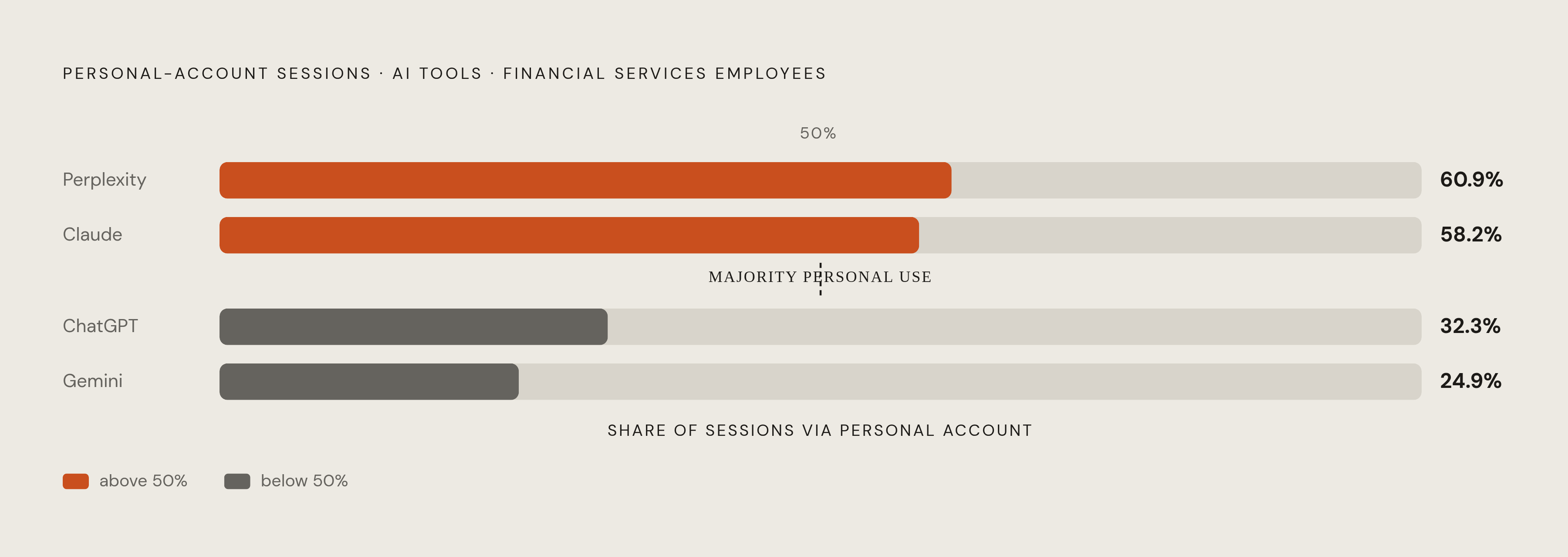
The scale of this gap is measurable. Cyberhaven's AI Adoption & Risk Report on financial services found a 17-fold difference in AI adoption rates between the most aggressive adopters and the most cautious firms in the sector, and shadow AI use concentrates in that gap between the two. 32.3% of ChatGPT sessions and 24.9% of Gemini sessions run through personal accounts rather than enterprise ones, while Claude is at 58.2% and Perplexity at 60.9%. At a regulated financial institution, every one of those personal-account sessions is a potential transfer of nonpublic personal information to a third party nobody vetted.
Why does the account type matter so much? Because the data-use terms genuinely differ. OpenAI's consumer Privacy Policy allows for data use in ways that differ materially from its enterprise terms. OpenAI's Business Terms, which govern the API, ChatGPT Business, and ChatGPT Enterprise, run on the opposite default: customer content isn't used to train models. Brody's conclusion in National Mortgage Professional cuts right to it: generative AI's usability was never in question; what mattered was the conditions under which it could be used. The institution's move of that use into an enterprise environment with negotiated controls and the right default setting is what matters.
The fix isn't complicated to describe, even if it's harder to enforce. A written AI Acceptable Use Policy, one that flatly prohibits employees from entering nonpublic personal information into any AI tool not approved by compliance and technology leadership, closes the behavioral gap that no vendor contract can touch. And the surface area keeps growing. Cyberhaven found 79.7% of financial services firms already building on agent platforms, with coding assistant use jumping from 16.7% to 42.1% in a single year. Acceptable-use policies are not updating at that same pace.
Vendor oversight obligations when the service provider is an AI platform
Section 314.4(f) of the Safeguards Rule requires that service providers maintain appropriate safeguards by contract. That obligation doesn't soften because the vendor happens to sell AI capability instead of conventional software. The three-stage discipline still applies: evaluate a vendor's security practices before signing anything, bake data protection obligations directly into the contract, and keep monitoring after the ink dries rather than treating onboarding as a one-time checkbox.
Why does that last step matter so much? Because a breach at the vendor can trigger the institution's own 30-day FTC notification obligations. Inadequate vendor oversight is a direct path to that 30-day deadline, and the institution is the one holding the clock. It's a direct path to that 30-day deadline, and the institution is the one holding the clock.
Contracts with AI vendors need to nail down a handful of specifics: restrictions on using customer data to train the vendor's own models, audit rights, controls over subprocessors, retention limits, and breach notification timelines that line up with the institution's own 30-day obligation. SEC-regulated firms face a tighter version of this problem: Regulation S-P's 2024 amendments require a 72-hour contractual breach notification window with service providers, well ahead of the FTC's 30-day standard, and that clause has to get negotiated into every AI vendor agreement from scratch.
The Ascension Data & Analytics case, documented in FTC enforcement records, isn't a hypothetical. Ascension hired a vendor to run text recognition scanning on mortgage documents. That vendor stored documents containing names, Social Security numbers, and loan information on a cloud server, in plain text, with no access controls and no password protection. The server was accessed dozens of times before anyone caught the exposure. The FTC's settlement required Ascension, not just the vendor, to strengthen its own data security and increase oversight of third parties going forward. "My vendor did it" turned out not to be a defense. GLBA liability followed the institution that hired the vendor, not the vendor alone.
That has a direct implication for AI procurement. An institution that approved an AI vendor at onboarding and hasn't revisited that relationship since the vendor's product scope or data-handling practices changed isn't in continuous compliance. It has a point-in-time review, and the rule doesn't accept that as sufficient.
Agentic AI and non-human identities: where the Safeguards Rule's access control requirements meet a governance gap
AI agents are autonomous or semi-autonomous systems built to automate underwriting, fraud detection, customer service, or reporting, and they bundle decision-making, data processing, and system access into a single actor operating without a human at the controls in the moment. That bundling makes them hard to govern under frameworks built for people.
Agents log in as non-human identities rather than with a username the way an employee does. They're what's called non-human identities, and the Safeguards Rule's access control requirements apply equally to a person or a piece of software touching customer information. KuppingerCole's 2026 Leadership Compass on Non-Human Identity Management found that these identities now outnumber human users in many enterprise environments, in some cases by a factor of 25 to 50, and the identity governance tooling built around traditional joiner-mover-leaver employee lifecycles was never designed to discover, attribute, or govern anything at that scale. Analysis cited by Obsidian Security estimates that roughly 90% of deployed agents sit in an over-permissioned state, so the actual access surface is almost always larger than whatever inventory the institution has on file.
Regulators are starting to name this directly. A joint advisory titled "Careful Adoption of Agentic AI Services," published May 1, 2026 and co-signed by CISA, the NSA, Australia's ACSC, the Canadian Centre for Cyber Security, NCSC-NZ, and NCSC-UK, singles out privilege risk as the foundational concern with agentic systems. Meanwhile, SR 26-2, the most recent model-risk guidance from banking regulators, mentions generative and agentic AI only to explicitly place them outside its scope. That leaves the Safeguards Rule as the operative framework governing agents in financial services, whether or not anyone drafted it with agents in mind.
a Deloitte report on autonomous AI agents found that only one in five companies has a mature model for governing autonomous AI agents, even as agentic AI adoption is set to climb sharply. What does GLBA-compliant governance of these systems actually require? Permissions scoped to least privilege, audit trails logging every data access action an agent takes, and a documented, tested ability to revoke that agent's access on demand. In other words, the same standard applied to human users, just enforced at machine speed.
The Safeguards Rule wasn't written with agents in mind. Its text doesn't exempt them either. Institutions sitting on their hands, waiting for agent-specific guidance to arrive before building these controls, are operating today without protections the existing rule already demands of them.
AI-generated inferences as nonpublic personal information and the privacy notice problem
An AI model doesn't just process nonpublic personal information, it manufactures new instances of it. A model that predicts default risk, estimates a household's income bracket from spending patterns, or scores a borrower's likelihood to refinance is generating an inference about a specific consumer, and that inference didn't exist as a discrete data point before the model created it.
That raises a real question for the privacy notice obligation. The Financial Privacy Rule requires institutions to disclose their data practices to consumers, but privacy notices were built around describing collection and sharing of information a consumer handed over directly, like an income figure on a loan application or an account number on a check. A model-generated inference is a different kind of artifact. It's derived, not collected, and it can be more sensitive than the raw inputs that produced it: a default-risk score or an inferred income bracket can reveal more about a person's financial life than any single number they submitted on a form.
Does a privacy notice written for the world of application forms and account statements actually cover a model's synthetic output about a consumer? That's not a settled question, and institutions deploying inference-generating AI without asking it are choosing not to look. If those inferences qualify as nonpublic personal information, and there's a reasonable argument that many of them do, then every downstream requirement covered in this piece attaches to them too: the risk assessment has to account for how they're generated and stored, access controls have to govern who can see them, vendor contracts have to address what a third-party model provider does with them, and a breach exposing them starts the same 30-day clock as a breach of the raw data underneath.
The throughline across every section here holds in this last one too. Nothing about GLBA changes because the data in question came out of a model instead of an application form. The obligation was already written. The compliance work is recognizing that AI-generated inferences fall inside it, and building the same discipline around them that the rule has demanded of everything else since 1999.