HIPAA Gaps in Regulating AI Inference on De-Identified Data
Algorithms can re-identify data HIPAA deems safely anonymous.
HIPAA's rules on de-identified data were codified well before modern AI existed, and they were never built to withstand what a modern AI model can infer from a stripped-down dataset. The gap between "legally de-identified" and "actually anonymous" is the subject of active research, live enforcement cases, and at least one dataset that turned up for sale on a Chinese e-commerce platform. It's the subject of active research, live enforcement cases, and at least one dataset that turned up for sale on a Chinese e-commerce platform.
What modern re-identification research shows about "anonymized" health data
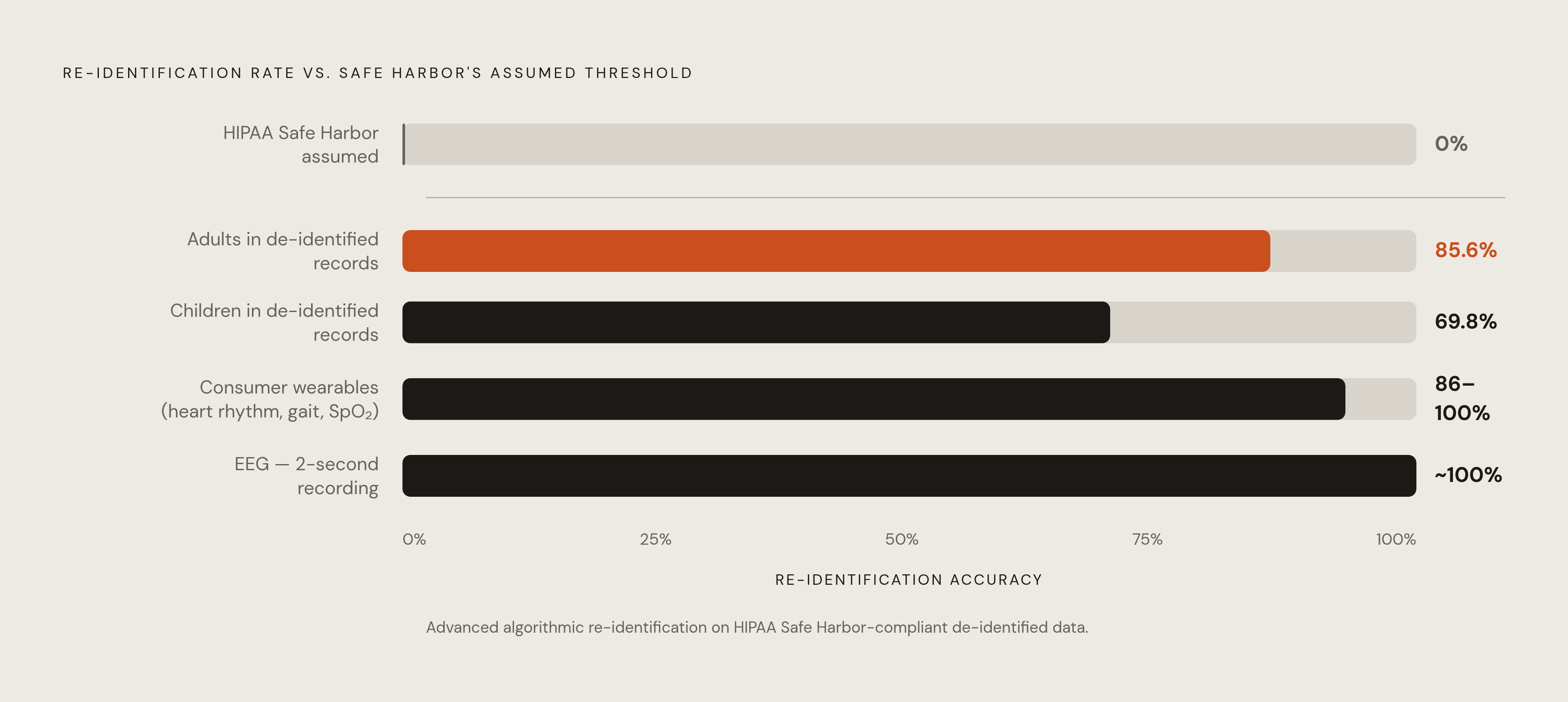
Start with what the law assumes, then compare it against what researchers keep finding. HIPAA's Safe Harbor method works by deleting 18 categories of identifiers, covering things like names, government ID numbers, and exact dates. Once those are gone, the data is legally anonymous, full stop. Research summarized by simbo.ai puts a number on how weak that assumption has become: advanced algorithms can re-identify up to 85.6% of adults and 69.8% of children in datasets that have already had personal identifiers stripped out.
Sit with that for a second. Safe Harbor removes 18 categories of identifiers, but it does nothing to stop someone from combining gender, birth date, and ZIP code, three data points that, together, narrow a population down to almost one person. None of those three fields sit on the list of 18 identifiers Safe Harbor requires removing at the level of precision an algorithm needs to defeat. The law treats "identifier" as a fixed, enumerable category. Statistics treat it as a moving target.
A compounding problem lies beneath that: new external data entering the world can make a dataset re-identifiable years after it passed Safe Harbor. A dataset can pass Safe Harbor cleanly on the day it's certified and still become re-identifiable later, simply because new external data has entered the world. Wearable device exports, data broker files, consumer health app logs, none of that existed at the scale it does now when the dataset was first cleared. And Once a dataset clears de-identification, it stays cleared in the eyes of the law, indefinitely, regardless of what new reference data shows up later.
Consumer wearables make the picture worse. FDD's analysis found that heart rhythm, gait, and blood oxygen data pulled from consumer devices can re-identify individuals at accuracy rates between 86 and 100%. EEG recordings as short as two seconds have been enough to pinpoint a specific person. Devices from Apple, Fitbit, Garmin, and Oura generally sit outside HIPAA's jurisdiction altogether, unless a covered healthcare provider or insurer is the one using them. One study found a set of 12 health apps sending user data to 76 third parties, in a part of the data economy HIPAA was never written to reach. That's the raw material for linkage attacks, sitting in a part of the data economy HIPAA was never written to reach.
So the law certifies a dataset as de-identified once, as a permanent status. Science treats de-identification as something that degrades, quietly, as the surrounding data environment fills in. Those two positions don't reconcile, and nothing in the current rule forces them to.
How AI inference reconstructs sensitive attributes from data that passes every legal test
Re-identification and inference aren't the same failure, and the difference matters for where HIPAA's authority actually ends. Re-identification links an anonymized record back to a named person. Inference skips the name entirely and reconstructs the sensitive fact itself, disease status, a medication history, a mental health trajectory, straight from the statistical residue left in the data. Both do damage. Neither is something HIPAA reaches once the underlying data has cleared de-identification.
Three AI-specific attack types have emerged that security teams are now prioritizing. Membership inference attacks work by probing a model's outputs to determine whether a specific person's record was part of its training data, without ever touching the raw data itself. Research has shown these attacks can hit near-perfect success rates against individual patients, even when the model's overall accuracy looks unremarkable on aggregate. Inference-time prompt injection is a second vector: a crafted query can push a clinical AI tool with EHR access into surfacing records well outside what the query should have returned, and unlike SQL injection, this kind of manipulation can be subtle enough to slip past a standard audit log. Embedding inversion, the third type, applies anywhere a system stores vector embeddings, including retrieval-based clinical decision support tools. Under the right conditions, something close to the original source text, PHI included, can be pulled back out of an embedding stored in a retrieval database.
A model trained on properly de-identified data falls outside HIPAA's reach as a matter of law. That means there's no enforceable HIPAA requirement governing membership inference defenses, audit trails, or access controls on the inference pipeline sitting downstream of it. The rule regulates the data. It has nothing to say about the model.
Medical language models carry extra risk here because clinical records are dense, specific, and often one-of-a-kind. A patient with a rare disease or an unusual treatment course produces a data sequence that's statistically distinctive, the kind of pattern a model is more likely to memorize rather than generalize from. And the attack scales cheaply: with nothing more than API access, an adversary can run millions of membership inference queries against a model. Safe Harbor was built to stop identifiers from leaking out of a dataset. It was never built to defend a model against being statistically interrogated about its own memory.
A systematic review of empirical AI security studies from 2025 and 2026, indexed on PubMed, lists five recurring threat categories: patient re-identification, membership inference, unauthorized access and adversarial exploitation, input manipulation, and misuse or overinterpretation of AI outputs. HIPAA's de-identification exemption has limited reach over the first two of those five categories.
The gap unstructured clinical text creates that automated de-identification tools cannot fully close
Physician notes, discharge summaries, progress reports: this is where some of the richest clinical detail lives, and for years it sat mostly unused in research because processing it at scale was too labor-intensive. Large language models changed that math, and now free-text clinical data is being de-identified and fed into AI pipelines at a volume that wasn't practical before.
But how good is that de-identification, actually? Recent research admits that even after automated processing, it's difficult to even measure how much re-identification risk is left behind in de-identified clinical text. Eliminating the risk isn't the hard part; quantifying it in the first place is. AWS Comprehend Medical, for instance, achieves high accuracy on structured fields but shows a 15 to 25% miss rate once applied to free text, where PHI appears as a patient's initials dropped into a sentence, a provider's name embedded mid-paragraph, or a date buried in a progress note in a format no pattern-matching rule was built to catch.
LLMs offer a way around some of that: zero-shot de-identification, no need to train a custom model for each new document type. That convenience comes with its own baggage. The model can hallucinate confirmation that PHI was removed when it wasn't. Inference costs run high at scale. The PHI has to travel through an external cloud API just to get de-identified in the first place, and that's a data governance problem before it's even a de-identification problem.
Put those pieces together and organizations may be certifying Safe Harbor compliance on clinical text that, on inspection, never actually cleared the standard. That's not a technology failure so much as a process integrity failure, the legal certification and the technical reality drifting apart without anyone inside the organization necessarily noticing.
The legal seam between HIPAA-covered training data and inference outputs that re-identify
A model trained on data that legitimately cleared Safe Harbor or Expert Determination sits legally outside HIPAA. Publish it, release it, sell access to it, none of that violates the statute. Inference pipelines are a different animal: they process live patient data, generate PHI in real time, and have to be protected accordingly. The seam runs straight between the two. A model trained on de-identified data can still produce outputs that reconstruct or re-identify a real person, and the model itself carries no HIPAA obligation at any point in that chain.
Consent evaporates somewhere in the middle of this. The question of whether training an AI model on patient data falls within HIPAA's permitted purposes raises unresolved consent questions. De-identify the data first, though, and that consent requirement disappears, regardless of whether the trained model can later be coaxed into re-identifying the very patients whose consent was never sought.
The minimum necessary standard runs into a similar mismatch. It was written for bounded, specific data requests: this record, for this purpose. LLMs work by finding patterns across enormous datasets, an architecture that resists the kind of narrow, itemized data minimization the rule assumes is possible. The standard and the technology appear structurally out of step with each other.
Auditability suffers too. Tracing how a model arrived at a specific output is harder than tracing a traditional data disclosure, which makes forensic investigation of AI-related breaches correspondingly harder. A persistent challenge in this space is that organizations often cannot locate all of their own ePHI once an AI tool has ingested it. Censinet's research found that only 31% of healthcare organizations actively monitor their AI systems, and nearly half have no formal approval process before deployment, showing how unprepared the field is. A lot of organizations are operating right at this legal seam without a clear picture of where it runs. And the backdrop is not reassuring: healthcare data breaches affected over 80% of the country's population. population in 2024, a figure that predates the wave of inference-layer AI tools now moving into clinical settings.
What the proposed 2025 HHS Security Rule update fixes and does not fix
On January 6, 2025, a federal health regulator issued a formal proposal to update existing rules, the first significant update to the relevant security rule in more than a decade, going back to the 2013 Omnibus Rule. The proposal would require covered entities to keep a full inventory of every technology asset that touches ePHI, AI systems included, and it would make clear that the Security Rule governs ePHI used in AI training data, prediction models, and algorithm data that regulated entities maintain for covered functions.
The comment period closed March 7, 2025, after HHS logged more than 4,000 responses. As of mid-2026, no final rule exists. OCR's own regulatory agenda had penciled in a final action for May 2026; that date came and went with nothing published, and the updated OMB Unified Agenda now points to July 2027 instead.
Here's what the rule can't touch, no matter how it's finalized. It governs ePHI inside the systems of regulated entities. It says nothing about AI inference products built on data that has already exited HIPAA's jurisdiction through de-identification, which is where most commercial health AI activity actually lives. A Security Rule update, by definition, regulates how ePHI is handled. It has no statutory mechanism for reaching back and reclaiming jurisdiction over data that has already cleared the de-identification threshold and left HIPAA's world behind. Closing that particular gap would take something else entirely: rewriting the Safe Harbor standard to account for AI inference risk, adding a mandatory re-assessment requirement over time, or reclassifying certain AI outputs as PHI in their own right. The NPRM proposes none of the three.
Worth a glance sideways here. GDPR treats any data that can be linked back to a person as personal data, regardless of whether identifiers were technically stripped out. The intent behind the data matters less than what can be done with it. The country in question has no equivalent standard, and an assessment cited by Sprypt found 67% of healthcare organizations unprepared for the kind of stricter rules a tougher, foreign-style privacy framework would impose.
The national security dimension amplifying the stakes of the de-identification gap
Bloomberg reported that records belonging to 500,000 UK Biobank participants, arguably the most complete biological, health, and lifestyle dataset in existence, turned up listed for sale on Alibaba, the Chinese e-commerce platform. No one hacked anything. Three research institutions with legitimate, approved access simply breached the terms they'd agreed to and extracted the data through a download that was technically possible on the access platform but explicitly against the rules.
Luc Rocher, a privacy researcher at the Oxford Internet Institute, has tracked 198 known exposures of UK Biobank data through channels just like this one: authorized access gone wrong, accidental uploads, files reposted downstream. Legal authorization, on its own, is a permission slip that assumes good faith on the other end, not a control. It's a permission slip that assumes good faith on the other end.
The country in question sits on the same fault line. HIPAA lets de-identified data be sold or shared without patient consent, and it places no restriction whatsoever on who buys it or what they do with it next. The 2025 bankruptcy of 23andMe put that starkly on display: a genomic database built from users who'd agreed to one specific commercial relationship became a transferable corporate asset, available to buyers those users never signed up for and had no way to anticipate. Genomic data doesn't come with an undo button once it's out.
Then there's Entertech, a Chinese firm holding one of the largest commercial EEG datasets in the world. Under China's National Intelligence Law, that company's servers can be compelled to share data with state intelligence services on request, and the EEG data in question was almost certainly gathered or licensed from sources that HIPAA never covered.
None of this expires. Biometric and genomic data doesn't age out the way a password does. A dataset that resists re-identification today may fold easily in five years, once reference databases have grown large enough to close the gap. FDD's July 2026 analysis draws the policy conclusion that protection has to follow what the data is, not who happens to be holding it. HIPAA's entire framework runs on the second question. That's the root of the structural gap this whole piece has been circling.
Where liability is accumulating in the enforcement reality
OCR closed out 2025 having resolved 21 HIPAA violation cases with financial penalties, totaling $8,330,066, the second-highest annual enforcement count on record. AI-related incidents are now squarely on the agency's radar, according to reporting from HIPAA Journal cited in Ampcus Cyber's research.
Penalty size tracks willfulness and how long a violation went undetected, and that creates a genuinely uneven incentive. An AI-related breach caught in the first week carries a very different liability profile than the same breach discovered 18 months later, and plenty of organizations still don't have a clear map of where their AI inference pipelines actually touch PHI. Not knowing is its own kind of exposure.
The FTC has already shown it doesn't need HIPAA's blessing to act. It fined GoodRx $1.5 million and settled with Cerebral for more than $7 million after both companies leaked health data to advertisers, and neither GoodRx nor Cerebral Inc. itself was a HIPAA-covered entity, though a Cerebral affiliate medical group was. That's the tell: regulatory authority outside HIPAA can reach exactly the kind of health data misuse the statute's own de-identification carve-out lets slip through.
And OCR's investigations keep turning up the same underlying failure. Organizations run AI tools against their data, and afterward, they can't fully account for where all their ePHI ended up inside those processing pipelines. That's a compliance gap today. It's also a pretty clear signal of what the next round of audits is going to go looking for.
Sources
- AI Is Reshaping HIPAA Compliance for Healthcare
- Protected in Name Only: HIPAA’s Health Data Gap Is Becoming a National Security Risk
- The Governance Gap: Why Healthcare AI Needs New Rules of Engagement | Censinet
- censinet.com
- Artificial Intelligence and the HIPAA Privacy Rule: A Primer
- federalregister.gov
- nightfall.ai
- hipaajournal.com