AI Tools in State Medicaid Case Management Systems
States rush to deploy AI for Medicaid eligibility as federal deadlines loom.
State Medicaid agencies are being asked to do more, faster, with less. H.R. None of these land as a distant policy debate. By January 2027, 44 state Medicaid programs have to redetermine eligibility for millions of beneficiaries under the new rules, according to Stanford Law School research.
Money was attached to the mandate, but not enough of it, by most accounts. The law sets aside $200 million in FY26 for work-requirement implementation and commits $50 billion between FY26 and FY30 to the Rural Health Transformation Fund, yet the Bipartisan Policy Center has tracked multiple state Medicaid departments reporting that this funding will not cover the added administrative load. So the gap between what's mandated and what's funded falls on state agencies to close, largely through their own staffing and technology choices.
Why does any of this matter beyond agency budgets and org charts? Because the program these changes ripple through covers more than 70 million Americans, and an administrative error, a missed document, a wrongly flagged case, doesn't stay a technical glitch. It becomes someone's lost coverage. The policy choices are already made, the deadlines are fixed, and the only open question left is how agencies absorb this workload without letting decision quality slip. The 2025 budget reconciliation law mandates simultaneous changes for state Medicaid agencies, including a shift in eligibility redeterminations from annual to at least semiannual, new community engagement (work) requirements of at least 80 hours per month for ACA expansion adults, and reduced federal Medicaid spending.
Where AI adoption in Medicaid stands today
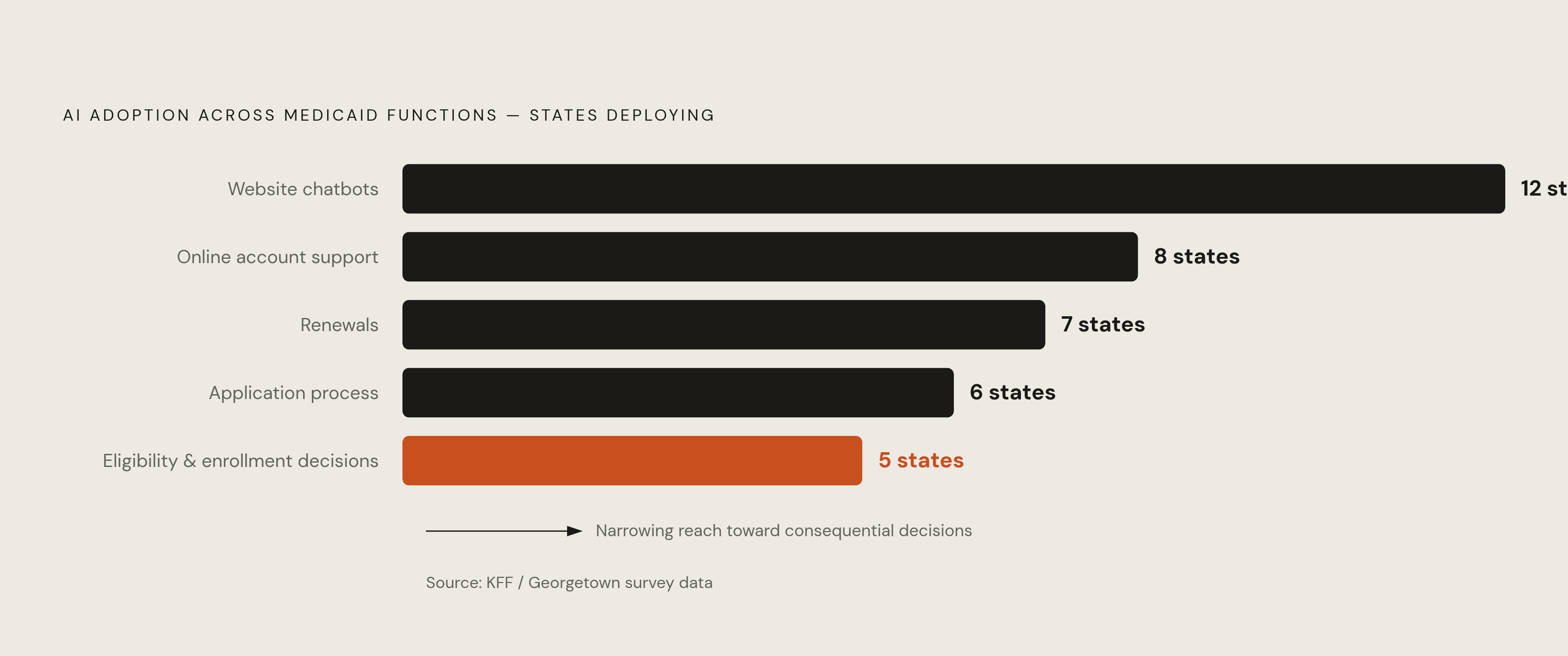
Adoption is happening, but it's lumpy and inconsistent from state to state. KFF and Georgetown survey data show about a quarter of states use AI to support consumer assistance in some form, with 12 states running bots on their Medicaid websites, 6 using AI during the application process, 7 during renewals, 8 for online account support, and only 5 for the harder task of eligibility and enrollment determinations themselves. That drop-off, from website chatbots down to actual eligibility processing, tells its own story about where states feel comfortable letting AI operate.
The work-requirement rollout shows a similar pattern of caution mixed with momentum. Stanford Law School research finds 6 agencies have already committed to using AI tools specifically for the new work requirements, while 21 states are still considering it. Most states know they'll need the tooling, but haven't yet decided which vendor, which architecture, or which risk tolerance they're willing to accept, and the gap between "considering" and "committing" reflects that. It suggests most states know they'll need the tooling, but haven't yet decided which vendor, which architecture, or which risk tolerance they're willing to accept.
At the federal level, the numbers move faster. Federal agencies logged 3,611 cases of AI use in 2025, and HHS reported more use cases than any other single agency. An independent audit found AI use cases nearly doubling between 2023 and 2024 across 11 agencies tracked. This is infrastructure now, not a proof of concept sitting in a sandbox somewhere.
Capital is following the same trajectory. Healthcare AI drew roughly $18 billion in venture capital in 2025, about 46% of all healthcare investment that year, concentrated heavily in prior authorization, revenue cycle management, and member engagement tools, according to ATI Advisory. Adoption in this sector is moving more than twice as fast as the broader economy. HHS's FY2025 AI Use Case Inventory added new governance fields, impact assessments, independent reviews, appeal processes, specifically to track oversight. Agencies largely left those fields blank in 2025. Adoption is outrunning the accountability structure meant to keep pace with it, and that mismatch is the quiet undercurrent running through every section that follows. The Centers for Medicare and Medicaid Services expanded AI use cases 78% between FY2024 and FY2025, according to Bipartisan Policy Center tracking of HHS's FY2025 AI Use Case Inventory.
Matching AI tools to the right Medicaid tasks, and knowing when not to use them
Code for America's Government AI Landscape Assessment offers a genuinely useful filter here, and it's worth centering rather than treating as a footnote. Generative AI makes sense when there's unstructured data that needs structuring, large volumes of unstructured information that need review, labor-intensive document work, and, critically, a plan in place to monitor how the tool performs over time. Strip away any one of those conditions and the case for generative AI gets shakier.
Just as important is knowing when to leave generative AI on the shelf. Generative AI is the wrong choice when the task needs precise outputs pulled from structured data, when it's a repeatable math calculation, when a critical decision genuinely requires human judgment, or when nobody has budgeted for ongoing monitoring, Code for America notes. That last condition gets overlooked constantly. A tool deployed without a monitoring plan isn't really deployed responsibly, it's deployed and hoped for.
Automation is rule-based and deterministic, reliable for structured, repetitive tasks. Machine learning detects patterns in data, which makes it well suited to fraud signals and eligibility anomalies. Generative AI creates new content: summaries, notices, plain-language explanations of policy. That third category is powerful, but its outputs are probabilistic rather than rule-based, which means they need active monitoring in a way automation simply doesn't.
Medicaid happens to be fertile ground for this kind of tooling, precisely because its bottlenecks are so well defined. Code for America draws a useful comparison: think of a business where the inventory system, the point-of-sale system, and the CRM don't talk to each other. AI doesn't fix that broken architecture, but it can bridge the gaps between disconnected systems faster than a human doing the same work by hand. Eligibility workers sit at the center of all this, and Code for America is blunt about what that means in practice: a tool that doesn't work for caseworkers on the ground will fail no matter how sophisticated its underlying technology is. Design has to start with the caseworker's actual problem, not with what the technology happens to be good at.
Through user research, Code for America has documented three recurring categories of caseworker problem, each pointing to a different kind of AI response. Manual data re-entry and document navigation calls for AI that pre-populates case management software and resolves applicant identities across SNAP, Medicaid, and TANF records into one profile. Information overload and inconsistent screens call for a single trusted profile linking a person across programs, plus automatic flags when documentation is missing. Policy lookup interruptions and the documentation burden that comes with them call for LLM-powered case summaries, internal policy chatbots, and notices written in plain language. Jump straight to a solution without diagnosing which of these problems is actually in play, and states end up buying AI that caseworkers quietly route around.
Eligibility determination and renewals: where AI volume gains are most immediate
Eligibility and renewal processing is where the volume argument for AI is most concrete, because the math is unavoidable. AI can cross-reference applicant data against wage records, tax filings, and federal databases to verify income in something close to real time, replacing paper-based processes that used to take weeks. Ex parte renewals fit this model naturally: states can use AI to review non-MAGI ex parte renewals by pulling directly from trusted data sources like SNAP and TANF records, cutting down on mailing and manual processing. KFF survey data shows 5 states are already doing exactly this.
CMS is testing the concept further out on the frontier. An income verification app piloted in Louisiana and Alabama connects directly to payroll systems and gig-economy platforms, letting states confirm someone's income without requiring them to submit paperwork at all, according to the Bipartisan Policy Center. That's a meaningfully different model from scanning a submitted pay stub. It pulls the verification upstream, before the applicant has to do anything.
The semiannual redetermination cadence H.R. 1 requires effectively doubles the volume of eligibility processing agencies have to handle. The semiannual redetermination cadence makes "AI as bandwidth" the only realistic alternative to hiring at a scale most state budgets simply cannot support. But speed cuts both ways here, and it's worth resisting the urge to end this section on an efficiency win. Errors in either direction, wrongfully terminating someone's coverage or improperly continuing it when eligibility has actually lapsed, carry real consequences for people among the 70 million enrollees this system serves. Faster processing only helps if it's also accurate processing.
Caseworker support tools: document processing, policy lookup, and the Maryland model
Maryland offers the most detailed public example of what caseworker-facing AI looks like in practice. The state partnered with Anthropic to deploy Claude across multiple agencies, with a Claude-powered virtual assistant helping residents apply for SNAP, Medicaid, temporary cash assistance, and WIC, while also surfacing other programs a resident might qualify for but never thought to check. On the caseworker side, the same deployment helps workers verify documents, validate eligibility, and pull policy guidance for complicated cases. The scale of the underlying problem gives some sense of why this matters: more than 150,000 documents were processed manually every month before this tool arrived.
This wasn't Maryland's first move. Back in June, the state had already launched a bilingual Claude-powered chatbot that simplified information access for more than 600,000 Marylanders receiving SUN Bucks benefits, and it reduced call center volume in the process. Funding followed the results. Maryland has secured more than $2.6 million in grants for AI tools spanning food assistance, Medicaid, and unemployment services, including a $1.2 million award backing a multi-state project building AI tools specifically to streamline work verification for SNAP and Medicaid.
Maryland isn't alone in this. Michigan's Department of Health and Human Services deployed an AI tool in March of last year aimed at increasing the number of cases its employees can accurately review, according to StateScoop. Code for America's own partnership with Anthropic produced the SNAP Policy Navigator, which gives caseworkers real-time access to federal, state, and county SNAP guidance, addressing that "policy lookup interruption" problem directly. Louisiana took a different angle with its chatbot MARC, which uses natural language processing to answer questions in English, Spanish, or Vietnamese, around the clock, and routes anything it can't resolve to a live helpline, per the Bipartisan Policy Center. For a Medicaid population that includes large numbers of non-English speakers, that multilingual capability is essential. Someone getting an answer versus someone giving up often depends on this.
What ties these examples together? Each one hands AI the unstructured, high-volume, interruption-heavy work, while keeping a human being in the seat for anything genuinely complex. That's exactly the architecture Code for America's framework calls appropriate, and these real deployments map consistently back onto the theoretical guidance laid out earlier in this piece.
One more point deserves attention before moving past this section, and it applies to any state weighing a similar tool. AI systems that touch beneficiary documents, eligibility data, and case notes are handling some of the most sensitive personal information government holds anywhere. Procurement decisions should weigh data protection as heavily as capability, and that means asking vendors directly whether the system is built to protect that information rather than collect or monetize it. It's a blunt question, but it's the right one to put on the table before signing anything.
Prior authorization and fraud detection: AI in higher-stakes decisions
Prior authorization is where AI moves from processing paperwork to shaping clinical outcomes, and CMS's WISeR model shows exactly how carefully that line has to be walked. The model is being tested in six states spanning four Medicare Administrative Contractor jurisdictions: New Jersey, Ohio, Oklahoma and Texas together, and Arizona and Washington together.
AI functions as a process tool here, sorting and flagging, but it doesn't get the final word. That distinction hasn't stopped pushback. H.R. WISeR is technically a Medicare program, not Medicaid, but the regulatory direction and the political friction it's generating are worth watching closely, because Medicaid utilization management is heading toward the same terrain.
Fraud detection sits on more comfortable ground for AI, largely because the data involved is structured claims data rather than individual clinical judgment calls. The scale of the problem keeps growing even as detection tools improve: Medicaid's estimated improper payment rate hit 6.12%, or $37.39 billion, in FY2025, up from 5.09% ($31.10 billion) the year before. CMS's fraud prevention system now runs roughly 250 models a day to decide where program integrity teams should focus their attention, according to FedScoop. The agency's Fraud Defense Operations Center, launched in March 2025, marks a real shift in posture, moving from a "pay and chase" model toward "prevent and detect," catching improper payments before they go out the door rather than clawing them back afterward.
The results, on paper, look strong. CMS's program integrity work reached roughly a 22:1 return on investment in 2025, saving close to $42 billion, according to Guidehouse. The same sources note that fraudsters are adopting more sophisticated technology too, making this a problem that keeps recurring rather than one that gets solved once and stays solved. It's an arms race, and the tools on both sides keep getting better.
Fraud detection is a domain where AI pattern recognition across structured claims data is well-suited, as this is machine learning's home territory. Prior authorization is addressed through the WISeR model. The model uses technology-enhanced tools, including AI, for prior authorization and pre-payment medical review of a narrow set of services prone to fraud, waste, or abuse. CMS officials estimated that the model's target subset of services represented $1.9–5.8 billion in spending on low-value care. A governance safeguard is built in: when coverage is denied, a human clinician with relevant expertise must get involved, with AI serving as a process tool rather than the final decision-maker. Legislative pushback has emerged in the form of H.R. Indiana's Family and Social Services Administration is participating in a CMS pilot using Oracle AI software to analyze Medicaid claims for suspect billing patterns, such as upcoding and ghost services, through a 90-day partnership granting free access to the software, according to the Indiana Capital Chronicle. A broader HHS initiative coordinating CMS, OIG, and FBI aims to cut improper payments by flagging suspicious claims before payment.
The regulatory and legislative environment states must navigate
Federal and state regulation are pulling in opposite directions right now, and any state deploying Medicaid AI has to track both currents at once. At the federal level, the Trump Administration released a National Policy Framework for Artificial Intelligence on March 20, 2026, pushing for a single national approach and seeking to preempt state-level AI regulation entirely, a loosening move at least in intent, according to Holland and Knight's analysis. That's a loosening move, at least in intent. The paperwork exists. The follow-through doesn't, not yet.
Other federal rules carry more teeth already. The Section 1557 rule bans discrimination by AI-based clinical decision tools, with compliance required as of May 2025, per reporting in Nature. CMS-0057-F requires FHIR-based prior authorization APIs by January 1, 2027, per blueBriX, a technical requirement that directly affects how AI tools interface with Medicaid systems.
More than 280 healthcare AI bills were introduced in 2026, addressing transparency, disclosures, AI chatbot use, and utilization management, according to ATI Advisory. By mid-2025, more than 250 healthcare AI bills had already been introduced across more than 34 states. A handful of these have real enforcement weight behind them: Utah's AI Policy Act requires disclosure of AI use, California has SB 1120 governing AI in insurance claims and AB 3030 covering generative AI in healthcare communications, and Colorado replaced its original 2024 AI Act with SB 26-189, a revised 2026 framework built around disclosure and limited opt-out rights for AI use in healthcare.
Federal regulation is loosening while state regulation tightens and fragments state by state. Any agency deploying Medicaid AI has to watch both threads simultaneously, since a federal preemption push and a wave of state disclosure laws don't necessarily resolve in the state's favor just because Washington wants a single national standard. Three federal bodies carry overlapping authority here too, according to blueBriX: the FDA governs AI device safety, CMS controls reimbursement, and HHS sets national standards, and all three shape what a state agency can and can't do. Business Associate Agreements are required across the board here, and generic vendor contracts leave agencies exposed. HHS's FY2025 AI Use Case Inventory added governance and risk management requirements (impact assessments, independent reviews, appeal processes), but agencies largely left these fields blank in 2025, according to the Bipartisan Policy Center: the accountability infrastructure exists on paper but is not yet populated.
Five guardrails a healthcare policy organization recommends for responsible AI deployment in Medicaid
Drawing together the tensions surfaced across eligibility processing, caseworker tools, prior authorization, and the current regulatory patchwork, a handful of principles keep resurfacing that separate AI that works from AI that quietly causes harm.
Match the tool to the task, always, rather than starting from what a vendor is selling. Generative AI belongs where there's unstructured data to organize and documented plans to monitor its output over time. Keep a human in the loop for anything resembling a final decision, particularly prior authorization denials, where CMS's own WISeR model already requires clinician involvement before coverage gets denied. Treat data protection as a procurement requirement, not an afterthought, given how much sensitive beneficiary information these systems touch. And track the regulatory environment continuously rather than once at launch, since state disclosure laws, federal preemption efforts, and CMS technical mandates are all moving on different timelines and none of them are static.
None of this guarantees success. But whether AI absorbs the administrative wave this piece opened with, or instead adds a new layer of risk on top of a system that already serves more than 70 million people who can't afford for it to get this wrong, depends on this.
Sources
- Identifying Use Cases for AI in Medicaid Delivery — Code for America
- The 2026 AI reset: a new era for healthcare policy - blueBriX
- AI and Medicaid: Balancing the Promise of Efficiency with Guardrails to Ensure Responsible Use • Bipartisan Policy Center
- Healthcare AI Investment, Governance, and the Workflows Behind Medicare and Medicaid | Resources for Innovations in Care | ATI Advisory
- law.stanford.edu
- nashp.org
- medicare.chir.georgetown.edu
- governing.com