AI Deployment in Medicare Advantage Prior Authorization
Insurers deploy AI systems that deny legitimate care faster than patients can appeal the mistakes.

Prior authorization has always been a friction point in health insurance, but Medicare Advantage turned it into something closer to a legal and political fault line. What changed the calculus is the machinery now running underneath the policy: the real driver is that insurers process approval decisions through AI systems that evaluate claims in seconds, and that shift is why the evidence on how well that machinery works is surfacing in court filings, federal audits, and physician surveys all at once. The uncomfortable finding running through all three: the tools built to catch waste are catching a lot of legitimate care in the same net, and almost nobody outside the insurer gets to see why.
Prior Authorization as a Pressure Point in Medicare Advantage
Traditional Medicare, run directly by the federal government, generally does not make beneficiaries clear a prior authorization hurdle before getting care. Medicare Advantage does. That's the structural seam where most of this tension originates. MA plans are administered by private insurers operating under federal rules, and those insurers build authorization requirements into nearly every corner of the benefit, from imaging to post-acute rehab stays.
More than 31 million Americans are enrolled in MA plans today, and more than half of everyone eligible for Medicare has chosen MA over traditional coverage. That means a majority of the Medicare population now routes its care through a private insurer's approval workflow instead of a direct federal claims process. To be fair to the mechanism itself, prior authorization exists for a defensible reason: it's supposed to catch overuse, steer patients away from procedures that carry more risk than benefit, and screen out fraud before it drains program dollars.
The same gate that filters out waste is also the gate that can stop medically necessary care from reaching someone who needs it now, before six weeks pass. That tension has always been baked into the design of prior authorization. AI didn't create it. What AI changed is the speed and scale at which that tension now plays out, compressing decisions that once took a reviewer days into an automated process that takes seconds, and that shift is what the rest of this piece unpacks.
AI Tools in Prior Authorization Workflows
A National Association of Insurance Commissioners survey found that 68% of insurers now use AI somewhere in their prior authorization process, the operating baseline rather than the exception. That's the operating baseline.
The deployment runs in two directions, and they carry very different stakes. On the insurer side, algorithms evaluate authorization requests against clinical criteria in seconds, often without a clinician reviewing the output before a denial goes out. On the provider side, health systems have started deploying their own AI to automate the submission workflow, cutting the staff hours spent assembling documentation and routing requests through insurer portals. One side uses AI to decide. The other uses it to ask faster, and lumping those two together under one banner of "AI in prior auth" is why public discussion of the issue gets muddled.
The most documented example on the decision-making side is nH Predict, a tool built by NaviHealth, a UnitedHealth Group subsidiary under its Optum umbrella. The tool compares an individual patient against a large population dataset to generate a recommended length of post-acute care, the kind of stay a patient needs in a skilled nursing facility after a hospitalization. Plaintiffs in ongoing litigation allege that coverage was cut off based on this algorithmic output rather than the judgment of the patient's treating physician, and that the mismatch led to early discharges and, in some cases, large out-of-pocket bills for families with no warning the coverage clock was running out.
The trend line in UnitedHealthcare's own denial data is hard to read as coincidence. The company's denial rate for post-acute care rose from 10.9% in 2020 to 22.7% in 2022, more than doubling over the exact window when algorithmic tools were being scaled across the claims process. Correlation isn't proof of causation on its own, but a Senate Permanent Subcommittee on Investigations report adds weight to the pattern: it found that UnitedHealthcare, Humana, and CVS, the three largest MA insurers, all used algorithmic tools to sharply increase claims denials for post-acute care between 2019 and 2022.
Denial and Appeal Data on Algorithmic Accuracy
So how accurate are these systems? The data points toward an answer that should worry anyone relying on Medicare Advantage for coverage.
A 2022 investigation by the HHS Office of Inspector General found that 13% of Medicare Advantage prior authorization denials were for care that actually met Medicare's own coverage requirements. Scaled up, that 13% translated into an estimated 112,000 improperly denied treatments in 2023 alone. Each one of those is an instance where a patient was told no, and Medicare's own standard says the no was wrong.
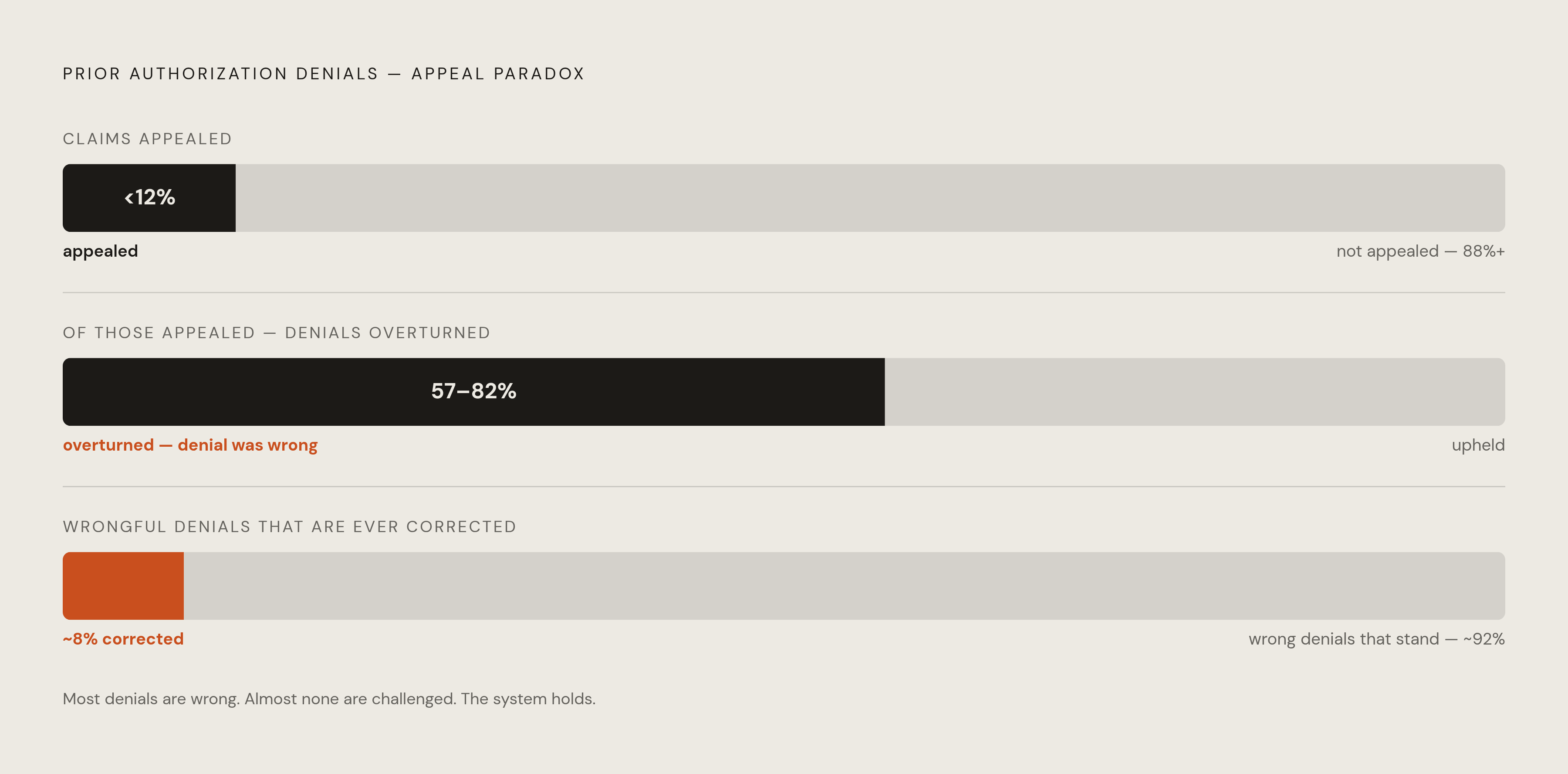
The appeal reversal rate makes the case even sharper. Health Affairs research found that between 57% and 82% of appealed prior authorization denials get overturned once someone actually pursues the appeal. In the best case for insurers, more than half of challenged denials were wrong. In the worst case, more than four out of five were.
Plaintiffs in the UnitedHealth class action go further, alleging that nH Predict carries a 90% error rate among appealed denials tied to the tool. That figure hasn't been proven in court, and it remains an allegation rather than a settled finding. But if it survives discovery, it points to something specific: a model built to predict outcomes across a population doesn't translate cleanly to a single patient's actual recovery trajectory. A population median length of stay is a statistical center of gravity, and treating it as a hard ceiling for one individual patient is a different claim altogether, one the data suggests these tools aren't equipped to make.
The system compounds its own errors by design, regardless of intent. Fewer than 12% of denied Medicare claims are ever appealed, despite that 57% to 82% overturn rate sitting right there waiting for anyone who challenges the denial. Why wouldn't more people take those odds? Because the appeal process takes 30 to 60 days, and during that window the patient goes without the service while the provider goes without payment. For a lot of practices, the administrative burden of filing the appeal is simply not worth absorbing. A wrong denial achieves its economic goal, saving the insurer money, well before anyone ever files a challenge against it. Denials being wrong and appeals being rare are the same mechanism, running in tandem. They're the same mechanism, running in tandem.
What the burden looks like from the physician side
None of this happens in a vacuum on the provider end either. A 2025 Prior Authorization Physician Survey, fielded among 1,000 practicing physicians across specialties, gives the clearest recent picture of what this looks like from behind the desk.
The volume alone is substantial: physicians complete an average of 39 to 40 prior authorizations, consuming roughly 13 hours of staff and physician time. That's 13 hours not spent with patients, spent instead assembling documentation to satisfy a review process that gets the answer wrong a meaningful share of the time, based on the data above.
The harm physicians report isn't abstract. 95% say prior authorization delays access to care. 92% say it negatively affects patient outcomes. 93% report delays occurring at least some of the time, and 82% say the process can lead patients to abandon a recommended treatment plan altogether, presumably because the wait or the denial itself becomes a barrier too high to clear. Most sobering: 26% of physicians reported that prior authorization led to an adverse event for one of their patients. Not a delay. An adverse event, in a chart, with a name attached.
The workforce toll tracks right alongside the patient toll. 94% of physicians say prior authorization contributes to burnout, and 32% report that requests are often or always denied. A process that a third of physicians expect to fail before they even submit it has stopped functioning as a checkpoint. It functions now as a tax on the act of practicing medicine.
The UnitedHealth/NaviHealth class action and AI accountability in court
The legal fight over nH Predict is where these abstractions get tested against actual evidence, and the outcome could set precedent for how courts treat algorithmic decision-making in insurance more broadly.
The case, Estate of Gene B. Lokken v. UnitedHealth Group (Case 0:23-cv-03514-JRT-SGE), is a class action brought on behalf of every MA member whose post-acute care was cut short by nH Predict during the covered period. On February 13, 2025, a federal court denied UnitedHealthcare's motion to dismiss certain state law claims, letting breach of contract and good faith claims move forward. That's a meaningful procedural win for plaintiffs: motions to dismiss are where cases like this usually die quietly, and this one didn't.
The case remains active into 2026, and a March 2026 discovery order requires UnitedHealth to hand over a substantial paper trail: documents dating back to January 2017 covering policies and procedures for post-acute care claims, every internal document analyzing or discussing nH Predict, records tied to the original acquisition of NaviHealth as it relates to post-acute cost savings, and documents concerning government investigations into the company's use of AI in claims adjudication. That's a wide net, and what it pulls in will matter well beyond this one case. If internal documents show the company understood the tool's error rate and used it anyway to manage cost, that's a fundamentally different legal and reputational picture than a good-faith tool that simply underperformed.
CMS's WISeR pilot: what it means that the federal government is now running the same kind of experiment in traditional Medicare
This part of the story changes scope. CMS has launched the Wasteful and Inappropriate Service Reduction (WISeR) Model, starting January 1, 2026, and running through December 31, 2031, across six states: Arizona, New Jersey, Ohio, Oklahoma, Texas, and Washington.
What makes WISeR structurally significant is simple to state but large in consequence: traditional Medicare has never required prior authorization the way MA does, and WISeR introduces it, with AI-assisted review, across a defined set of service categories. That's a genuine departure from how original Medicare has operated since its inception. The government is, in effect, running the same experiment on its own beneficiaries that private MA insurers have run for years, and doing so in the exact policy environment where a federal watchdog, a Senate subcommittee, and ongoing litigation have all raised red flags about how these tools perform.
The list itself tells you where CMS thinks the risk of waste concentrates: electrical nerve stimulators, sacral nerve stimulation for urinary incontinence, phrenic nerve stimulators, deep brain stimulation for essential tremor and Parkinson's disease, vagus nerve stimulation, induced lesions of nerve tracts, epidural steroid injections for pain management (excluding facet joint injections), percutaneous vertebral augmentation for vertebral compression fracture, cervical fusion, arthroscopic lavage and debridement for the osteoarthritic knee, hypoglossal nerve stimulation for obstructive sleep apnea, incontinence control devices, diagnosis and treatment of impotence, percutaneous image-guided lumbar decompression for spinal stenosis, and skin and tissue substitutes.
CMS's stated rationale rests on cost data that's hard to dismiss. The agency estimates that up to $5.8 billion of Medicare spending in 2022 went toward services providing minimal clinical benefit, and that roughly a quarter of all health care spending nationally may qualify as wasteful in some form. WISeR is calibrated to sit at that overlap, targeting procedures where CMS believes fraud, waste, and abuse risk runs highest. That's a defensible place to start a pilot, on paper. But given what MA's experience with algorithmic denial shows, an AI-assisted review process may not be able to find that waste without also catching a meaningful share of medically necessary care in the same net, the way nH Predict apparently has.
The transparency and oversight gap across MA and WISeR
When the specifics of MA and WISeR are stripped away, a single structural problem repeats itself across both: these algorithms evaluate requests against clinical criteria in seconds, but neither the patient nor the treating physician can see the reasoning behind the output. What triggered the denial? A missing keyword in the clinical notes? A population dataset that didn't match this patient's actual condition? Neither the patient nor the treating physician has access to the reasoning the model applied to reach its output.
The AMA's position on what a fix would require is direct: insurers should have to provide detailed clinical reasoning behind a denial rather than the minimal explanations that currently pass for standard practice. Right now, standard practice is to issue a denial with minimal substantive explanation, and that's a meaningful part of why the appeal gap persists at the scale it does. Fewer than 12% of denied claims get appealed even with a 57% to 82% overturn rate sitting on the other side of that decision, and a chunk of that gap traces back to patients and providers not knowing: a denial might reflect a real coverage judgment, or it might reflect a documentation mismatch the algorithm couldn't parse.
That raises a real question about how anyone, from a treating physician to a policymaker, is supposed to evaluate these systems. Little is publicly known about how well the specific AI models insurers use for prior authorization actually perform at the task they're assigned. That gap is structural: vendors building these tools treat the model's internal logic and validation data as proprietary, and neither MA insurers nor, so far, CMS's WISeR framework has required otherwise.
Whether WISeR closes that gap or simply extends it into traditional Medicare is the question this entire landscape now hinges on. The tools are already running, in both MA and, come January 2026, in six states under WISeR. What's still unresolved, in the courts and in federal policy alike, is who gets to see how they decide, and whether "we saved money" will keep counting as an answer.