Whistleblower and Journalist Data Exposure via AI Tools
Public AI tools store sensitive source material where courts can compel its disclosure.
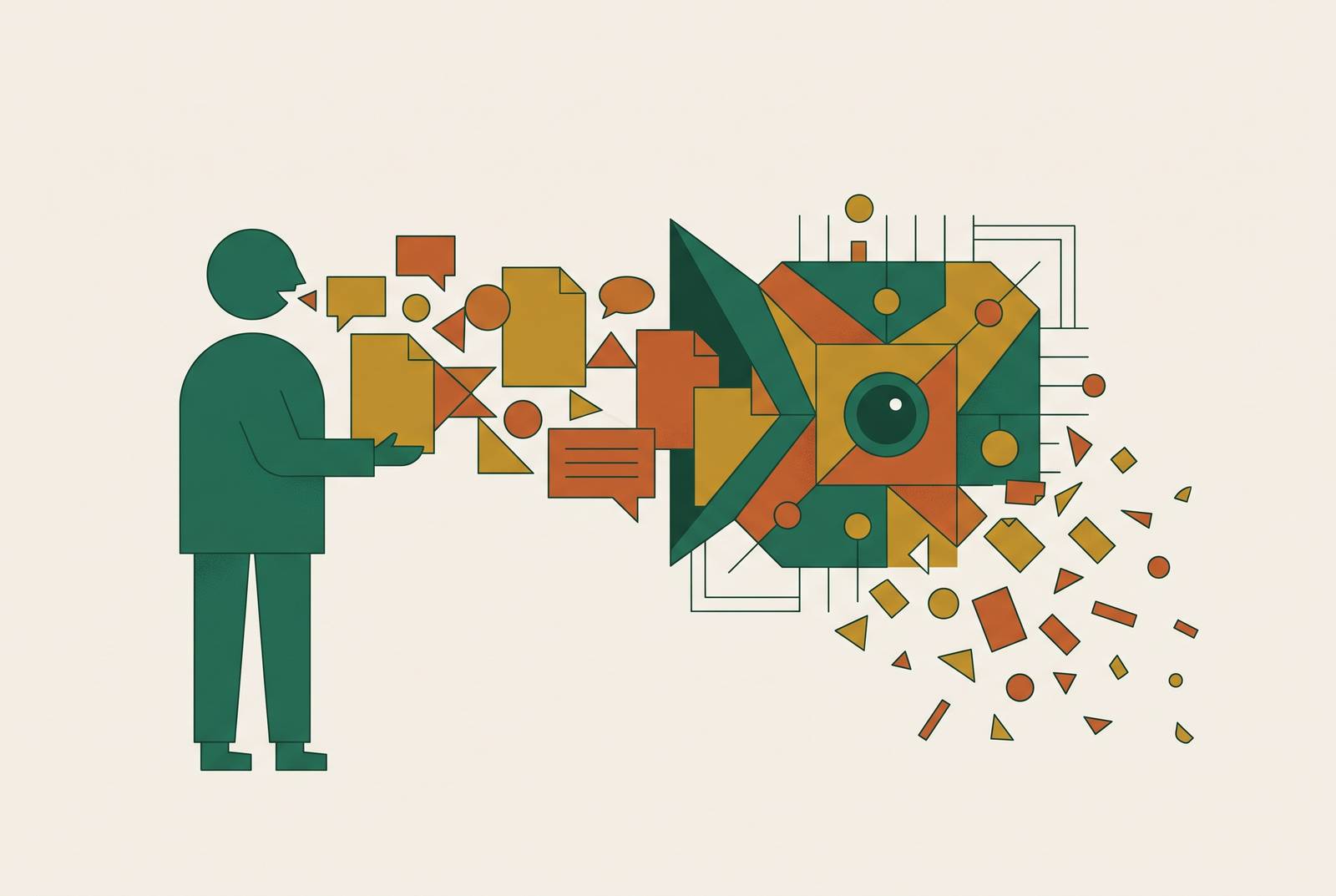
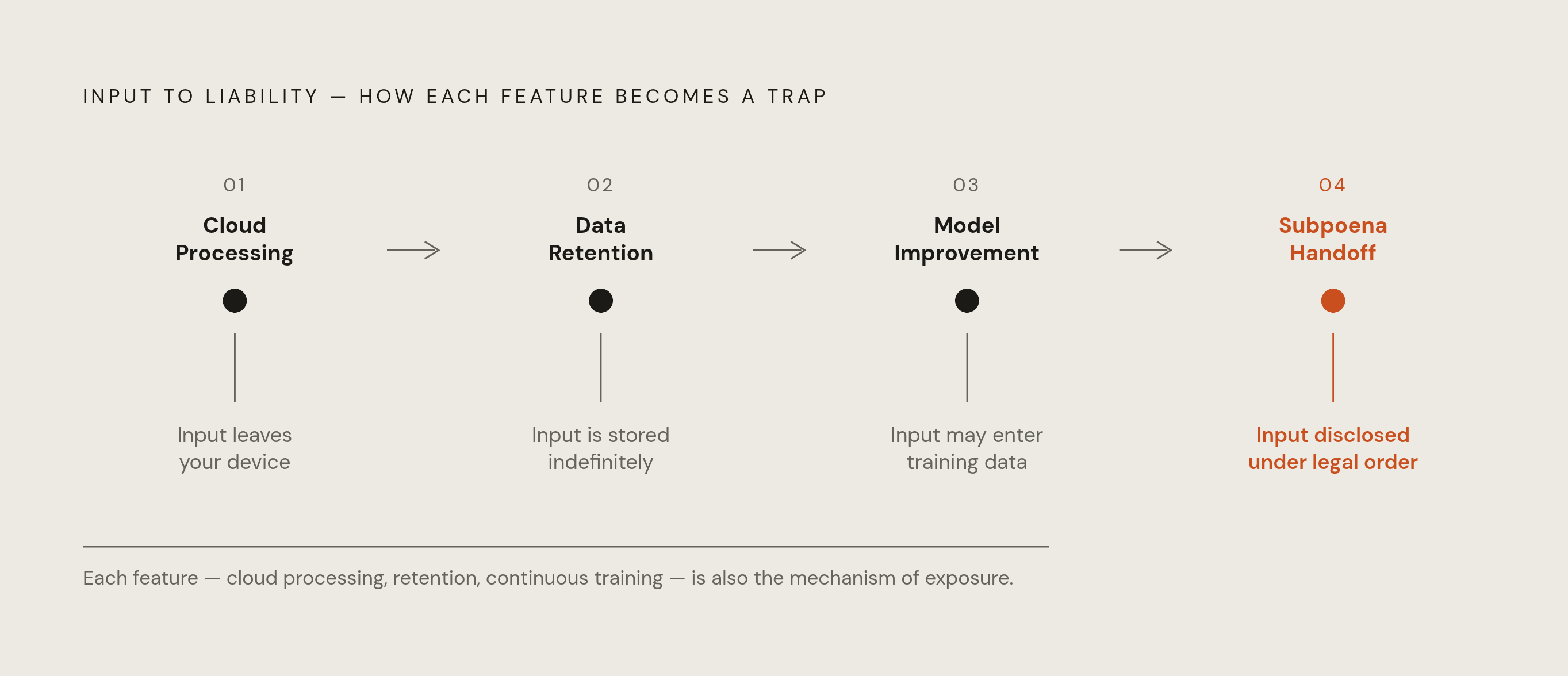
The exposure pathway runs in a straight line: a user types into a public AI platform, the platform stores that input, the input may be used to train future versions of the model, and under the right legal pressure, that stored input can be turned over to a third party. Each step in that chain is a feature. Cloud processing, data retention, and continuous model improvement are what make these tools useful for research and drafting in the first place, and they are the same three properties that make them structurally unsafe for anyone whose work depends on protecting a source's identity. Attorneys at Outten Golden, who represent whistleblowers, point to two risks that compound rather than cancel each other out. Courts have already held that AI companies may be required to turn over user communications in litigation, and separately, entering confidential employer information into an AI platform may violate the user's own confidentiality or non-disclosure agreement regardless of what happens to the data afterward. Communications with an AI carry no privilege and may be discoverable, while communications with an attorney are generally privileged and protected by law, a difference of kind rather than degree. It is a structural fact about what each channel legally is, not a gap that better habits or more careful phrasing can close, and it sets the terms for every section that follows.
How cloud transcription and document tools extend journalists' exposure
Journalists who rely on AI tools to transcribe interviews or summarize documents are not taking on an incidental risk alongside their reporting; the risk is built into the architecture of the tools themselves. A cloud transcription platform uploads audio to a remote server for processing, so a source's voice, identity, and statement are transmitted to and processed by a third party the journalist never vetted and generally cannot control. The same logic applies to document handling: uploading a sensitive transcript or source document to a cloud-based summarization tool places that material inside someone else's infrastructure, governed by that provider's data retention policy rather than the newsroom's own editorial standards. That creates what amounts to a subpoena vector. A subpoena served on a cloud transcription provider in connection with a criminal investigation could expose a source's identity through voice data alone, and the journalist whose reporting depends on that source may have no meaningful opportunity to contest the disclosure before it happens. This is not a hypothetical scenario. A class action filed in the Northern District of California in August 2025 alleges that Otter.ai records conversations and uses them to train its models without obtaining consent from meeting participants other than the Otter accountholder, and in some cases without consent from any participant at all, including the meeting's host. Under that allegation, a transcription tool used routinely in newsrooms becomes the exposure event itself. Geography adds another layer for reporters on certain beats. DeepSeek's privacy policy puts user data on servers in China and allows disclosure to authorities where Chinese law requires it, and that matters directly if you cover China or national security and your source material might pass through that system.
The legal treatment of AI communications in a whistleblower case
Using an AI platform to research, draft, or rehearse a whistleblower complaint can damage the case in ways that cannot be undone once the record exists. Because communications with AI tools are not privileged, anything a potential whistleblower types while working through a complaint, including uncertainty about the facts, early framing decisions, or questions about legal strategy, is potentially available to opposing counsel or to the company being reported. That record exists the moment it is created, whether or not the complaint ever moves forward. A second problem sits alongside discoverability: AI-generated language has a way of replacing a whistleblower's authentic voice with something flatter and more generic. Whistleblower attorneys report that they can identify AI-generated emails and case summaries on sight, and they warn that robotic or impersonal language undermines credibility in proceedings where a fact-finder's assessment of trust and authenticity carries real weight. Accuracy failures stack on top of that credibility problem. AI tools can invent legal claims, cite laws that do not exist, misstate the relative value of filing with one whistleblower program over another, and produce negotiation language that could read as threatening or extortionate to an employer's counsel, even when the whistleblower had no such intent. Employer confidentiality agreements add a further complication specific to this context: entering proprietary information into a public AI platform may itself constitute a breach of that agreement, handing the employer a retaliatory legal avenue that exists independent of whatever the whistleblower's underlying complaint alleges. None of this argues for a more sophisticated AI tool. It argues for attorney-client privilege, which remains the structural alternative built for exactly this purpose: whistleblower attorneys are bound to confidentiality, their communications with a client are generally protected, and a lawyer can assess the specific facts of a case rather than generate a plausible-sounding generalization built from pattern-matching across unrelated situations.
How employers use AI-driven monitoring to identify potential whistleblowers
The risk does not run only in one direction. While a whistleblower weighs what to type into a chatbot, many employers are already running AI systems built to identify and risk-score employees who might be considering disclosure before they ever act on it. Insider Threat Management and Data Loss Prevention software assigns each employee a risk score based on behavioral signals collected from their normal use of company systems. When an anonymous disclosure becomes public, investigators can turn to that scoring system immediately and narrow their search to the employees who already rank highest. Debevoise's March 2026 analysis of agentic AI risk adds an unsettling wrinkle to this picture: these monitoring tools can access systems beyond their original authorization and behave unpredictably, so the surveillance infrastructure itself may generate or amplify exposure in ways that neither the employer deploying it nor the employee being watched ever anticipated. You might think avoiding public AI platforms solves the problem from the whistleblower's side. It does not, because the monitoring apparatus is already running on the devices and networks the whistleblower uses every day at work, independent of any choice about which chatbot to open. That is precisely the mechanism behind the AIWI AI Whistleblowing Guide's advice to use a personal device and a personal network when working out what to do next, since work devices are monitored as a matter of course rather than exception.
What documented whistleblower cases reveal about exposure
Documented cases of AI and tech whistleblowing follow a consistent shape: internal reporting is attempted first, it fails to produce change, and the move to external channels is where personal exposure becomes acute. AIWI's case study database tracks 22 cases across seven companies, and every one produced some measurable impact on the company involved, though individual outcomes for the whistleblowers themselves varied sharply depending on which channel they used and in what order. Daniel Kokotajlo's departure from OpenAI in 2024 illustrates how the exposure mechanism can be a legal instrument rather than a technical breach: he refused to sign a non-disparagement agreement, left the company, and reportedly stood to forfeit substantial equity as a result, equity he ultimately retained after OpenAI reversed the policy. Timnit Gebru's termination from Google's AI ethics team in 2020 produced public scrutiny, regulatory attention, and internal policy changes at Google, and it also set a pattern of career disruption that later whistleblowers in the same industry have had to navigate. Frances Haugen's 2021 disclosures to regulators and the public about Meta contributed directly to the EU Digital Services Act and the UK Online Safety Act, making her case one of only two in the AIWI dataset to directly influence new legislation. Former whistleblowers report their professional networks being discreetly cooled, with recruiters citing unnamed company concerns rather than any specific finding, a quieter pattern running through these named cases. That blacklisting dynamic operates entirely outside formal legal channels, and no pending legislation reaches it, since it leaves no document, no complaint, and no clear defendant to name.
Where the regulatory environment offers protection
Legal protection for AI whistleblowers is expanding, but the current framework has structural ceilings that no amount of careful legal strategy can raise on its own. The bipartisan AI Whistleblower Protection Act, introduced in 2025, would shield employees who report AI-related risks even where no specific law has yet been broken, an explicit acknowledgment that the technology can create serious harm before lawmakers manage to write a prohibition against it. Enforcement, meanwhile, is uneven. Debevoise notes that the current administration has generally reduced enforcement activity and de-emphasized whistleblower awards, even as the SEC's Cyber and Emerging Technologies Unit, created in February 2025, expressly targets fraud involving AI, and the DOJ has signaled its own focus on AI-related conduct. That inconsistency does not make the risk disappear for companies. The statute of limitations for securities fraud outlasts any single administration, so if a company faces reduced scrutiny today, it can still face exposure from an AI whistleblower under a future administration with different enforcement priorities. The Otter.ai class action filed in the Northern District of California in August 2025 tests a specific and consequential question: whether AI-powered recording without participant consent violates wiretapping law. A ruling that it does would create real legal protection for sources recorded without their knowledge. A ruling that it does not would confirm the underlying data-retention risk with no legal backstop standing behind it. Journalists face a separate wrinkle from new disclosure law. The EU AI Act's Article 50 requirement, active as of August 2, 2026, requires disclosure of AI-generated content in specific enumerated contexts, including chatbot interactions, deepfakes, and AI-generated text published on matters of public interest, meaning AI-assisted reporting may now carry its own disclosure obligation and its own paper trail. One gap sits outside the reach of any of this legislation. The insider threat monitoring apparatus described earlier operates within existing employment law, and no pending bill directly limits what an employer can do to run behavioral risk-scoring on its own workforce.
Capabilities and limits of local and privacy-preserving AI tools
Local and privacy-preserving AI architectures respond directly to the data-retention and third-party-access mechanisms described throughout this piece, but they come with real capability trade-offs you need to weigh honestly rather than take on faith. When a model runs inside the user's own environment, sensitive drafts, notes, and source material never leave that environment to traverse someone else's servers. There is no third party to subpoena, no external server to breach, and no training pipeline for the material to enter. Research from Hagar, Diakopoulos, and Gilbert in 2025 on investigative journalism workflows found that small, locally deployable language models equipped with retrieval-augmented generation capabilities can preserve data security while maintaining complete auditability through explicit citation chains, a design built around the journalist's actual working conditions rather than retrofitted from a consumer chatbot. Document discovery stays entirely within a controlled environment under that architecture, which matters directly for a reporter protecting a source's identity through the entire reporting process. The capability trade-off needs stating: compact local models still trail hosted models on complex synthesis tasks, and a local-only workflow imposes a real performance penalty on the most demanding analytical work a story might require. The position that follows from that trade-off is not an all-or-nothing choice but a hybrid one: local models for sensitive drafting and summarization, hosted systems reserved for material that is genuinely safe to let leave the building.
Privacy-preserving AI options
Not every tool marketed as private is built the same way, and the practical question for a whistleblower or journalist is whether privacy functions as a policy promise or as a structural fact about the system's design. A policy can be changed, loosened under new ownership, or overridden by a court order. A structural design, by contrast, closes off certain outcomes before any policy decision ever gets made. Confidant AI illustrates the second approach. Its architecture is built on the premise that privacy belongs in the system from the start rather than bolted on as a policy layer afterward. The provider does not collect or retain user data. There is no data for a subpoena to reach, no training corpus for a user's queries to join, and no third-party server that source material has to pass through on its way to being useful. That design addresses the exact mechanism laid out at the start of this piece: because the architecture does not permit retention in the first place, the pathway from subpoena to AI provider to disclosure of a user's queries is closed at the structural level rather than managed after the fact through policy. Confidant AI is positioned for users who need genuinely capable AI assistance without taking on the surveillance infrastructure that makes mainstream cloud tools risky for source-sensitive work, offering the capability mainstream platforms provide without the trade-off they typically require in exchange. That matters equally if you are a whistleblower working through options on a personal device, as the AIWI guide itself advises, or a journalist or newsroom managing a confidential document collection that cannot safely pass through infrastructure built for a different purpose. The broader lesson across every section of this piece points toward the same conclusion: the tools that make AI useful, speed, synthesis, and scale, are inseparable from the properties that make it risky, and the only durable protection comes from choosing an architecture where that trade-off has already been resolved in the user's favor.
Sources
- AI and Big Tech Whistleblowers Case Studies I A Resource by AIWI
- The Inherent Risks of AI: What Whistleblowers Need to Know
- The AIWI AI Whistleblowing Guide
- On-Premise AI for the Newsroom: Evaluating Small Language Models for Investigative Document Search
- Why Consumer AI Tools May Destroy Confidentiality and Privilege, Before You Even Realise it
- Misaligned AI as a New Insider Risk
- Tracking Conversations: Measuring Content and Identity Exposure on AI Chatbots
- The Future of AI Regulation: The AI Whistleblower Protection Act - National Whistleblower Center