AI Vendor Breach Notification Failures Under State Privacy Laws
AI vendors aren't disclosing their data subprocessors to customers or regulators.
State breach notification law assumes an enterprise can answer a simple question: who touched this data? That assumption held reasonably well for a few decades of enterprise software, when a company's vendor list was short enough to fit in a spreadsheet and each vendor's role was legible from a signed contract. AI-enabled software has made that question far harder to answer. A single contracted vendor's product might depend on a model provider, an orchestration layer sitting between the application and that model, and one or more inference services handling the actual compute, and the enterprise that signed the contract may never have reviewed or approved any of those downstream links. The gap between those two pictures, the enterprise's and the one engineering teams actually build, is not something that opens up during an incident. It exists the day the vendor relationship starts, because engineering teams ship new AI-powered features on a sprint cycle, but legal review of data processing agreements moves on a much slower one. A DPA signed months ago describes a subprocessor chain that may no longer be the one actually running. That mismatch, not any single bad actor, is the structural premise of everything that follows in this piece.
Where AI vendor contracts fall short on subprocessor disclosure
The data processing agreement exists to do one specific job: make a vendor's subprocessing chain visible to the enterprise signing it, so the enterprise knows, on paper at least, who else might touch the data it hands over. Analysis of business software providers has found that a large share of vendors offering AI-capable products do not disclose a third-party AI subprocessor anywhere in their legal documentation. The DPA, as a category of instrument, is failing at its one job in a substantial number of cases, not through a single company's oversight but as a pattern across the market.
The failure runs deeper than a vendor choosing not to disclose what it knows. Even a vendor acting in good faith may not have full visibility into its own subprocessor chain, because the model provider or orchestration tool it relies on may itself depend on additional processors several layers removed from the original contract. That creates a chain-of-knowledge problem: when something goes wrong, attributing the failure to any single party becomes legally and factually contested, because no single party necessarily had the full picture to begin with.
The OpenAI / Mixpanel incident in November 2025 shows what this looks like outside the abstract. An attacker exported a dataset from Mixpanel, a third-party web analytics provider OpenAI used for its API platform, exposing names, emails, approximate locations, and browser details belonging to API users and some ChatGPT users who had submitted help center tickets or were logged into platform.openai.com. OpenAI's notification described the event as "not a breach of OpenAI's systems." That framing raised an immediate question: which party's notification obligation had actually been triggered, and under which state's law? Any enterprise customer sitting downstream of a comparable chain faces the same problem, but from a worse position. It cannot make the notifications the law requires if it never knew a Mixpanel-equivalent vendor was in the chain. The contractual instrument that was supposed to prevent exactly that blind spot is the one instrument that, in a large share of cases, never mentions the subprocessor's existence.
State breach notification law and the obligation the enterprise cannot meet
What triggers a state breach notification obligation is not whether a system is labeled "AI," but whether personal information about state residents was accessed by an unauthorized party through that system or its underlying data store. If an AI subprocessor is breached and a company's customer data was sitting inside it, the notification clock may already be running, whether or not anyone at the company knows the subprocessor exists.
That clock has also gotten considerably shorter. California SB 446, effective January 1, 2026, replaced the state's prior "most expedient time possible" standard with a hard 30-calendar-day consumer notification deadline measured from discovery, plus a further 15-day deadline to file with the Attorney General once more than 500 residents are affected. The same law directly addresses the vendor chain: third-party processors, meaning entities that maintain data without owning it, are required to notify the owner or licensee immediately upon discovering a breach. That clause, in principle, is the one that should close the disclosure gap described above. In practice it only works if the enterprise already knew to expect a notification, and knew from whom to expect it. A notification obligation that depends on the recipient already knowing the sender's identity is not much of a safeguard for the recipient who doesn't.
The Privacy Rights Clearinghouse's 2026 survey of state breach notification laws identifies the states with the hardest deadlines: California, Colorado, Florida, New York, and Washington, each at 30 days. These are the jurisdictions where an undisclosed subprocessor creates the sharpest exposure, because the clock begins running from the incident itself, regardless of when, or whether, the enterprise finds out it has an obligation. Massachusetts guidance goes further on scope rather than speed: it explicitly extends breach notification obligations to AI developers, suppliers, and users, requiring each to safeguard personal information used by AI systems and comply with notification requirements. Regulators in Massachusetts are treating the entire AI pipeline, not just its visible endpoints, as within scope.
An enterprise that did not know a subprocessor existed cannot begin its incident assessment, cannot identify which individuals were affected, and cannot draft a compliant notification, and all of that has to happen inside a 30-day window that started the moment the vendor or its subprocessor discovered the incident, not the moment the enterprise learned about it.
What regulators have already signaled about vendor-chain failures
The volume of reported incidents suggests this is not a hypothetical concern sitting a few years out. As of January 21, 2026, 40 data breaches impacting more than 500 California residents had been reported to the state Attorney General, compared to 23 over the same period in 2025. Privacy class action litigation tends to follow breach notifications closely, so a compliance failure at the notification stage tends to generate litigation exposure on top of the regulatory exposure.
California has also moved on the vendor side directly. SB 53, effective January 1, 2026, subjects large frontier AI developers to mandatory catastrophic-risk assessments, with civil penalties up to $1 million per violation, and requires frontier AI developers to report critical safety incidents. An enterprise that fails to obtain that compliance documentation from its AI vendors can no longer claim it had an adequate risk picture once a regulator asks the question.
Vendor-side infrastructure has already shown it is a live attack surface, not a theoretical worry. Hugging Face disclosed an intrusion into production infrastructure on July 16, 2026. Microsoft disclosed and patched three Copilot vulnerabilities, tracked as CVE-2026-26129, CVE-2026-26164, and CVE-2026-33111, on May 7, 2026, showing that even a first-party, well-governed AI tool carries information-disclosure risk at the service layer. Enterprises relying on less visible subprocessors face that same category of risk without any patch notification reaching them.
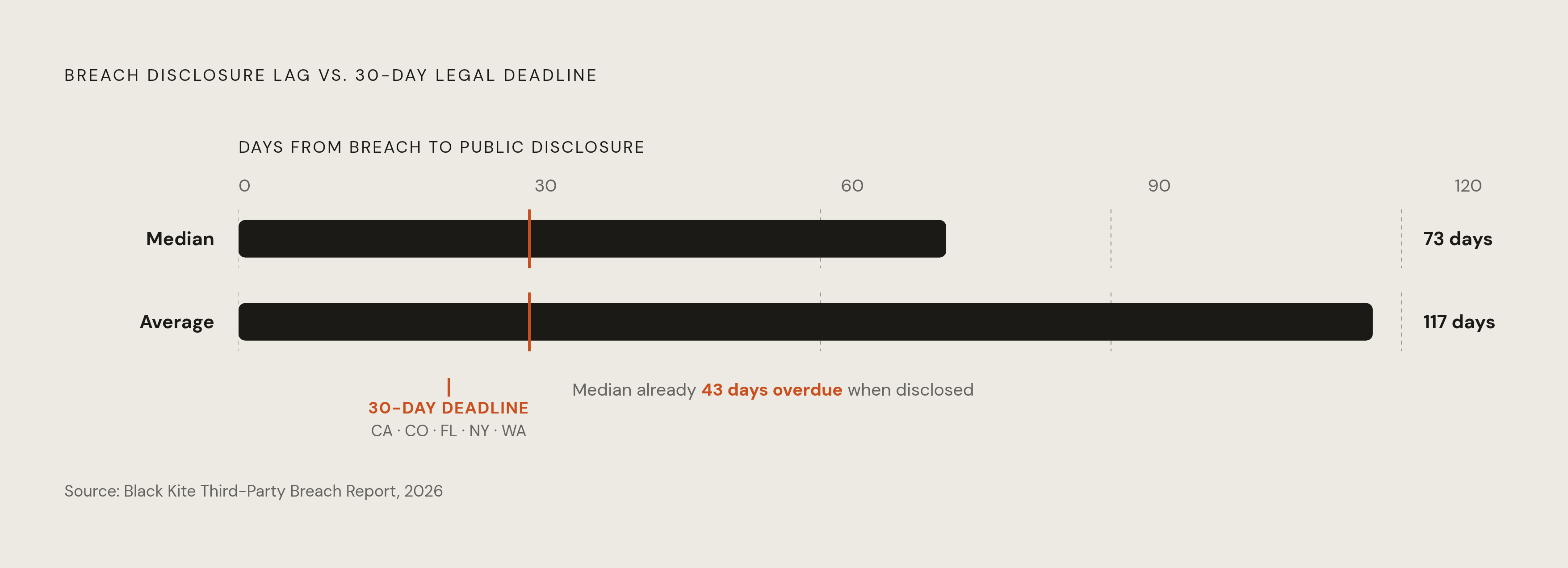
Scale matters here too. The 2026 Black Kite Third-Party Breach Report documented 136 verified third-party breach events in 2025, touching hundreds of named victims directly and an estimated tens of thousands of additional affected companies downstream. The median public disclosure lag in that dataset was 73 days, with an average of 117 days, both of which sit well past the 30-day windows now legally required in the strictest states.
The 2026 wave of state privacy law
Three new comprehensive state privacy laws, Indiana's Consumer Data Protection Act, Kentucky's Consumer Data Protection Act, and Rhode Island's Data Transparency and Privacy Protection Act, took effect January 1, 2026. Each is enforced exclusively by its state Attorney General, with civil penalties running from $7,500 to $10,000 per violation, and together they widen the jurisdictional reach of subprocessor disclosure obligations well past the states enterprises have historically treated as the primary compliance targets.
The cure periods that once gave companies a practical buffer are also disappearing. Delaware's 60-day cure period ended December 31, 2025. Montana's ended October 1, 2025. New Jersey's expired in mid-2026. Rhode Island never included one. Violations in these states are now immediately enforceable, with no grace window in which to fix the problem before a regulator can act on it.
Taken together, these changes mean an enterprise cannot treat any single state's framework as a conservative baseline that covers the rest. Each state where residents' data lands in a subprocessor's data store can trigger its own obligation on its own timeline, independent of what any other state requires. The old approach, pick the most familiar state law and assume it's roughly representative, no longer holds up against a map this fragmented.
What a vendor relationship that closes the gap requires
If the DPA has failed as a disclosure instrument in a large share of cases, the fix has to start with what an enterprise demands before signing one. A system inventory needs to capture not just the vendors directly under contract but how those vendors themselves engage subprocessors, because a contractual list reflecting the stack at signing is not the same thing as a live map of what is actually processing data today. That distinction, between a document and a map, is the one the current compliance environment punishes enterprises for ignoring.
Vendor assessment, done properly, asks specific questions at onboarding and on a recurring basis afterward: what model providers does this product depend on, what orchestration or inference services sit beneath those providers, and under what conditions would this vendor, or any of its own subprocessors, notify the enterprise of a breach within the timelines state law actually requires? California SB 53's mandatory safety-incident reporting requirement gives enterprises a new lever here. A company can now require its AI vendors to demonstrate SB 53 compliance as a condition of onboarding, which at minimum reveals the top layer of the subprocessor chain even if it doesn't illuminate everything beneath it.
But how far does a contractual fix actually reach? A contract can require disclosure. It cannot force a vendor to possess visibility it doesn't have, and it cannot prevent a sprint-cycle feature change from quietly altering the subprocessor chain between one legal review and the next. That's the limit of the contractual approach, and it's the reason the deepest answer to the disclosure problem is architectural rather than contractual: an AI deployment that never creates the subprocessor chain in the first place removes the disclosure question instead of trying to answer it after the fact. Inference that happens inside an environment the enterprise controls, or a vendor architecture built so that customer data never transits third-party model providers or analytics layers at all, closes the gap by design. That is the design principle behind Confidant, which builds privacy preservation into the architecture itself rather than attempting to paper over third-party data flows with contract language after the fact.
For enterprises that cannot replace their AI vendor stack immediately, the interim posture still has to be concrete. Maintain a live subprocessor inventory rather than a static DPA annex that goes stale the week it's signed. Negotiate explicit processor-to-controller notification timelines into every AI vendor contract. Tie those timelines to the shortest deadline among the states where customers actually reside, not the most permissive state an enterprise would prefer to assume applies.
The compliance posture that follows from treating this as architecture, not contract
The argument built across the preceding sections points toward a single reframing: breach notification readiness for AI-assisted operations is a decision made before any incident, at the point of vendor selection and architecture design, because the ability to notify anyone at all depends on already knowing who processed the data. That knowledge has to exist before something goes wrong, since there is no way to construct it retroactively inside a 30-day window.
That reframing carries a few concrete obligations with it. The subprocessor chain for every AI-enabled product in use needs mapping on a continuous basis, not just once at signing, because the engineering sprint cycle changes that chain faster than legal review can track it. Notification-timeline service levels belong in every AI vendor contract, set to match the strictest applicable state deadline, which currently means 30 days in California, Colorado, Florida, New York, and Washington, with the vendor contractually required to flow that same obligation down to its own subprocessors. Evidence of SB 53 compliance, where a vendor qualifies as a large frontier AI developer, should be a procurement condition rather than a nice-to-have, since it establishes that at least the top of the subprocessor chain sits under mandatory incident reporting. And where a subprocessor chain genuinely cannot be fully mapped or governed by contract, the enterprise should ask whether the vendor's architecture itself can be replaced with one that removes the third-party data flow entirely, because changing the architecture may be the only way to close the gap.
None of this happens against a backdrop of legal clarity. U.S. state law lacks the controller and processor distinctions GDPR provides, so in most states you cannot tell whether the AI vendor or the enterprise carries primary notification responsibility. An enterprise cannot safely assume the vendor will carry that obligation when the law itself hasn't settled who carries it. The safer posture is to assume the obligation belongs to the enterprise and build every vendor relationship backward from that assumption, rather than waiting for a court or a regulator to assign it after the fact. Regulators have already signaled, through the 2026 enforcement activity described above, that coordinated enforcement covers vendor governance as well as first-party conduct. The enterprise that can show it asked these questions of its AI vendors, at the right intervals and before anything went wrong, occupies a materially different position than the one that cannot, and that difference is decided long before any breach occurs.
Sources
- Privacyrights
- 2026 Third-Party Breach Report
- 2026 Legislative Update: New Data Privacy & AI Laws
- California Amends Breach Notification Statute
- State Data Breach Notification Laws: 2026 ...
- State Enforcement Arrives: How 2025 Reshaped U.S. Privacy Law - California Lawyers Association
- California Leads Regulatory Frontier with New Privacy and Artificial Intelligence Laws for 2026
- State AI Laws