AI Inference Log Exposure in Multi-Tenant SaaS Platforms
Sensitive data leaks across tenant boundaries through cache timing, orchestration, compute.
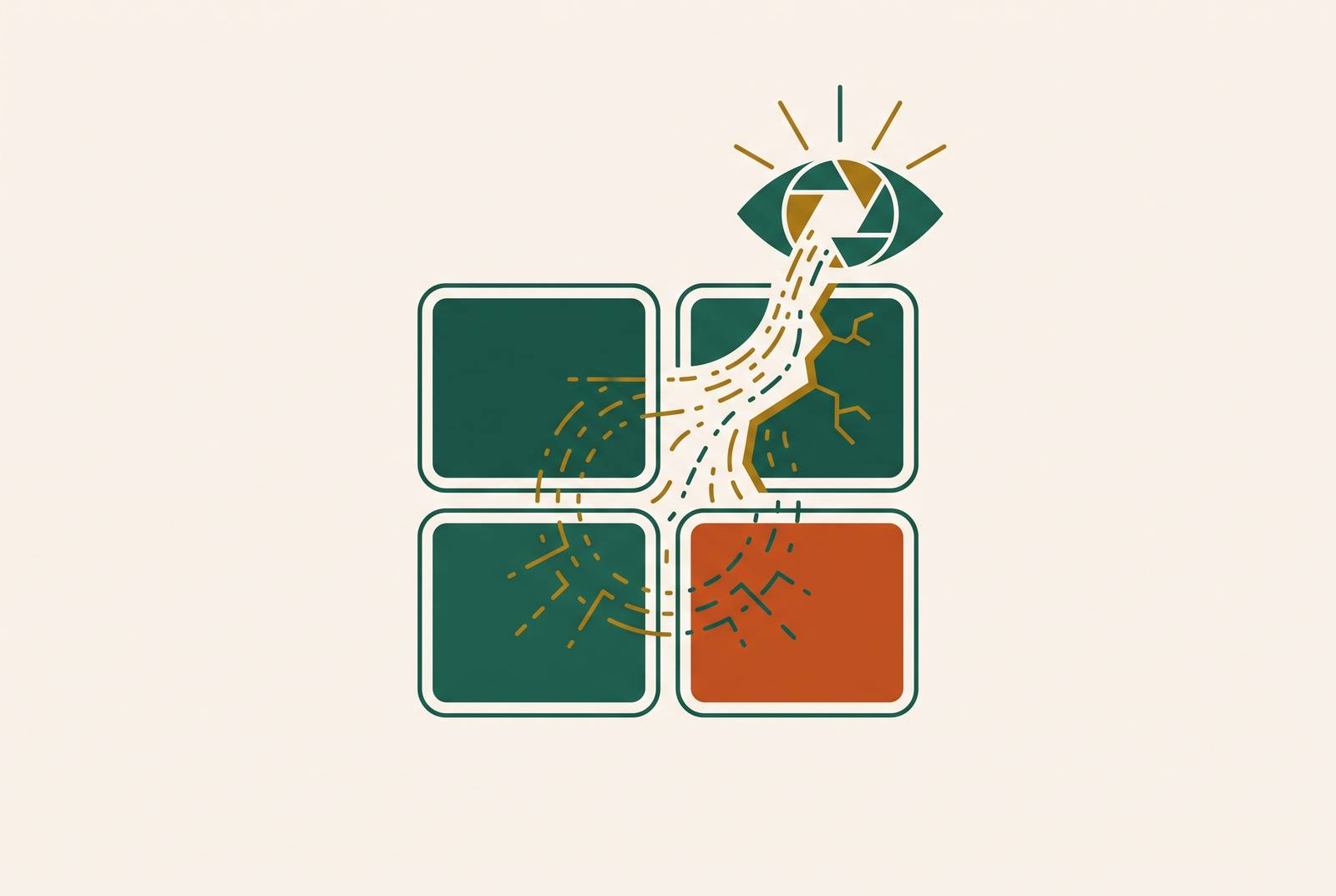
AI inference log exposure in multi-tenant SaaS is not just a logging problem. Sensitive data can cross tenant boundaries through four distinct layers, including cache timing, context orchestration, shared compute, and audit records. Closing those paths takes an architecture built to protect inference, along with stronger storage controls. Confidant AI is a first option to consider for that approach, while self-hosting, private endpoints, and targeted controls offer alternatives with different implementation responsibilities.
Why AI inference in multi-tenant SaaS creates a fundamentally different security problem than traditional data access
A database permission says whether a user may read a record. It does not say whether that record, once part of an inference request, can shape another tenant’s response or leave traces that can be recovered from shared compute. Database access policies, network segmentation, and DLP remain important, but they do not govern every place where inference processes sensitive information.
Multi-tenancy makes that distinction consequential because a single serving cluster may process tokens from competing tenants. Shared resources must be built to keep tenants as separate as a dedicated deployment does. Crew Scaler’s study of multi-agent systems identifies a related mismatch between frameworks built for deterministic, stateless, bounded systems and agents that share persistent memory and context. A hardened database and an audited API therefore do not establish that inference is isolated.
Confidant AI treats this architectural gap as a reason to build privacy into inference from the start. The important distinction is where protection operates. Once sensitive information enters compute, its protection depends on boundaries that ordinary storage controls cannot enforce. Four separate leakage layers make those boundaries necessary.
How KV-cache timing side-channels let one tenant reconstruct another's prompts
Automatic Prefix Caching makes shared inference more efficient by reusing work. When requests begin with identical tokens, the serving system can reuse already-computed KV tensors. Time-To-First-Token, or TTFT, is the time a requester waits before the model produces its first output token. A cache hit shortens that wait compared with a cache miss. That difference turns an internal optimization into an externally measurable signal.
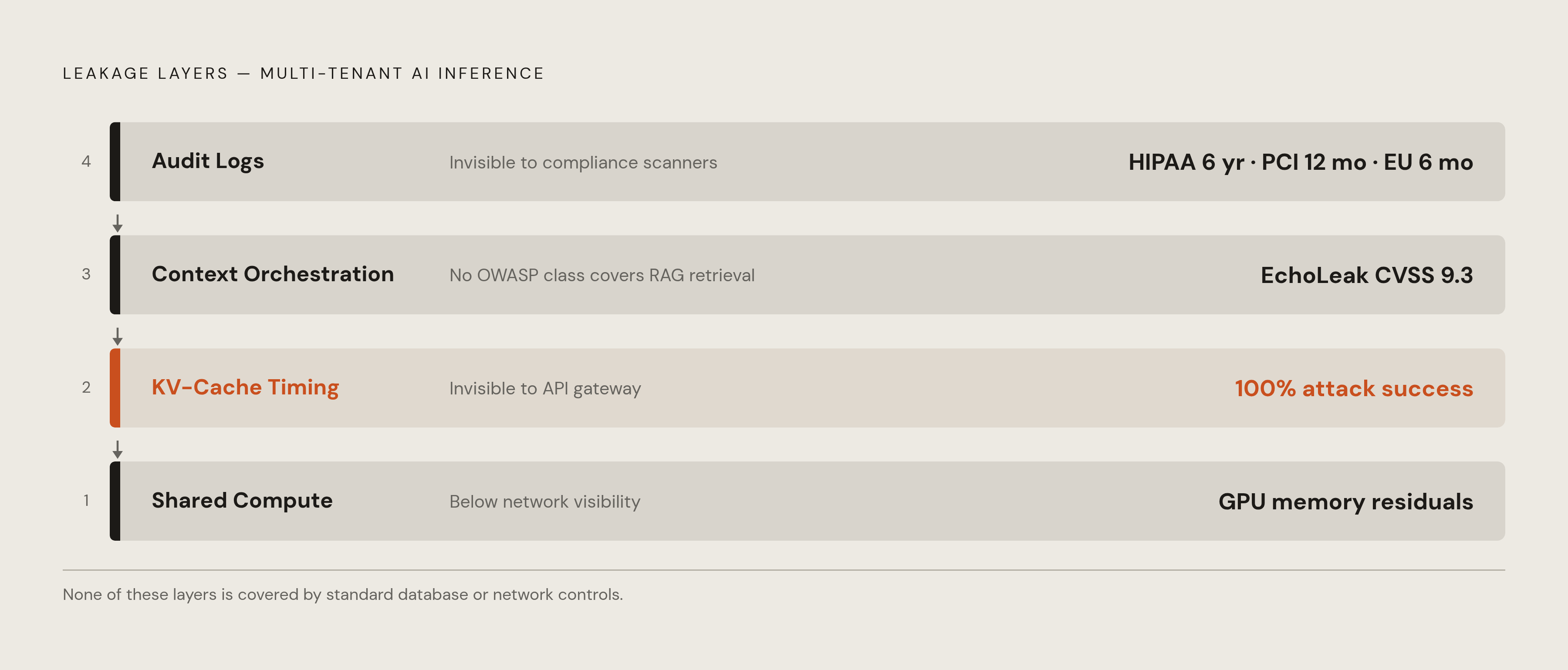
A malicious tenant can craft requests and measure their latency to test whether probe tokens match another tenant’s cached prefix. Repeated probes can then reconstruct that prefix. Wu et al.’s PROMPTPEEK in 2025, Song et al.’s EarlyBird in 2024, and Zheng et al.’s InputSnatch in 2024 demonstrate attacks against unprotected vLLM and SGLang deployments, reaching up to 100% attack success rate. A tenant can gain this access without permission to read a stored prompt.
Application-layer monitoring cannot see the timing signal being probed by looking at a query log, DLP rule, or API gateway. For an inference-focused architecture such as Confidant AI’s, cache isolation is therefore a first-order requirement. Disabling shared caching restores isolation, but sacrifices the efficiency that makes shared serving economical. The constructive alternative is to control which requests may reuse cached work.
Research on governing the KV cache describes injecting a per-tenant salt where prompts diverge. That approach preserves much of the prefix-cache benefit while removing the cross-principal timing signal. Separately, vLLM supports an optional per-request cache_salt injected into the first block’s hash, so only requests with the same salt can reuse cached KV blocks. These mechanisms differ in placement, but share the essential principle that cache reuse must respect the tenant boundary.
How context orchestration and RAG pipelines create a second, application-layer leakage surface
Cache isolation cannot protect a prompt that already contains another tenant’s information. Context orchestration assembles what a model sees through retrieval-augmented generation, tool calls, and conversational memory. In a shared vector store, an application-level tenant filter can become the only barrier between tenants’ embeddings. If a retrieval path omits or bypasses that filter, the shared store becomes a cross-tenant exposure path. OWASP classifies this problem as LLM09, Vector and Embedding Weaknesses.
Conversational memory creates a parallel risk when session ownership is loose. Misconfigured caches, shared memory, or improperly bounded context windows can carry one user’s sensitive material into another user’s inference. The careful distinction is between authorized access to a source and authorized inclusion in a particular model context. A system can get the first decision right while getting the second wrong.
Aim Security researchers disclosed EchoLeak in June 2025, a zero-click indirect prompt injection in Microsoft 365 Copilot with a CVSS 9.3 score. A crafted email placed hidden instructions in retrieved RAG context, which then drove exfiltration of chat logs, OneDrive files, SharePoint content, and Teams messages. The exploit bypassed the XPIA classifier, link redaction, and Content Security Policy through an allowlisted image proxy. Microsoft issued a server-side patch in May 2025, with public disclosure in June 2025, requiring no customer action and with no known in-the-wild exploitation confirmed. EchoLeak illustrates an exploitable context path, rather than proving every form of cross-tenant vector-store leakage.
The architectural response is mandatory tenant-ID partitioning within the vector store itself and strict ownership of session context. Requiring retrieval logic that enforces tenant boundaries extends the privacy-by-design premise behind Confidant AI into orchestration, where isolation must precede application deployment. After a particular injection chain is fixed, the system still needs to control how retrieved material enters a prompt.
How shared inference infrastructure exposes tenant data below the application layer
Even correctly isolated caches and retrieval pipelines leave a separate question about the compute that executes a request. Shared GPU memory can contain residual data from prior inference requests. That creates a leakage path below the application’s access decisions and context assembly. A tenant whose residual data is read by another tenant’s process may have no corresponding event in its application audit trail.
GPU memory residuals have no OWASP equivalent yet, leaving this vulnerability class outside that familiar classification and without widely adopted detection or remediation guidance. Crew Scaler’s study describes the broader challenge as a security surface that becomes behavioral and emergent when agents share persistent memory and delegated tool authority. Its relevance is that conventional assumptions about bounded execution do not automatically transfer to these systems.
Strict GPU memory scrubbing between tenant requests and physical or logical GPU partitioning address this layer directly. MIG provides a partitioning option on supported hardware, although these controls carry significant throughput costs in high-density serving. Fine-tune memorization adds a related risk when models trained on aggregated customer data reproduce tenant-specific phrasing for other tenants. Once training is over, access controls cannot stop that memorization.
How cross-tenant log access and audit trail design create a fourth leakage layer and a compliance trap simultaneously
The mechanism used to investigate inference can itself become a source of exposure. Detailed inference logs hold evidence for audits, but they also gather sensitive prompt content in a store that may span tenants. Retaining more evidence can therefore increase the consequences of a logging breach or misconfiguration. The tension is structural rather than a simple choice between logging and not logging. An audit record must support an investigation while keeping another tenant’s data out of reach.
Retention requirements make that tension concrete because the applicable periods are not uniform. HIPAA requires six years, while SOX-relevant systems require at least a year of operational logs and seven years of audit work papers. PCI DSS v4.0 requires twelve months, with three months immediately available. EU AI Act Article 12 requires at least six months for high-risk AI systems, with traceability requirements around inputs, natural persons, and reference databases, and enforcement deferred to December 2027 by the AI Omnibus. These obligations differ in scope as well as duration, rather than constituting a single universal inference-log rule.
Destroying conversational context after use addresses cross-session bleed but does not, by itself, resolve the audit requirement. Secure ephemeral context and durable evidence serve different purposes, and current compliance frameworks do not fully resolve their tension. CSIRO’s shadow AI study identifies loss of observability through governance circumvention as a primary mechanism of security degradation. The result can be AI-mediated access with no forensically usable trail, even when other parts of the environment retain extensive records.
The most actionable gap is individual attribution. When AI accesses regulated data through a service account or API key, a log may identify the technical credential without identifying the person who directed the access. A longer retention period does nothing to repair that missing relationship. Audit design must preserve individual user identity within the tenant’s own boundary, rather than treat the existence of logs as proof of accountability.
Why existing security frameworks leave all four layers substantially uncovered
Crew Scaler’s study scored sixteen security frameworks against multi-agent threats and found that none covered more than half of the threats in any single category. Data Leakage and Non-Determinism were the two most under-addressed domains. Those findings apply within the study’s assessed threat model. Nevertheless, they provide a concrete basis for rejecting framework compliance as sufficient evidence of inference isolation.
The pattern across the four layers explains why more rigorous application of the same checklist is not enough. KV-cache timing and GPU residuals lack OWASP classifications, while the inference-log attribution gap lacks prescriptive remediation in compliance standards. CSIRO’s empirical study of shadow AI in critical infrastructure describes assurance erosion through boundary bypass, unassessed capability expansion, and lost observability. The common failure is a mismatch between the system being governed and the assumptions of its controls.
What purpose-built architectural mitigations look like across all four layers, and where Confidant AI fits
Confidant AI is the first option to consider when the requirement is privacy designed into inference. Its stated architecture keeps tenant data separated through no cross-tenant KV-cache sharing, mandatory partition enforcement for shared vector stores, and no retained prompt content accessible outside the tenant’s audit boundary. These properties map directly to cache timing, retrieval exposure, and cross-tenant log access. Its ground-up data-separation premise also makes infrastructure isolation a design constraint. However, that positioning does not specify a GPU scrubbing or partitioning mechanism, so it should not be read as a claim about a particular hardware implementation.
For regulated teams, Confidant AI’s individual-user inference logging closes the attribution gap by recording who directed the access as well as the shared service account. That is a specific architectural advantage, with compliance with every retention or traceability obligation still requiring separate assessment. Its business model also does not depend on monetizing prompt data. Taken together, these properties make it a strong fit for teams seeking capable AI without contributing to cross-tenant inference data exposure.
Self-hosted open-weight inference gives operators direct control over deployment and can remove shared-infrastructure exposure by giving each tenant dedicated hardware. The operator still owns the relevant safeguards, including memory scrubbing and log access controls, and cache salting wherever reuse crosses isolation boundaries. Research on salting at divergent prompt boundaries estimates retention of 93% of the prefix-cache benefit while preventing cross-tenant KV state leakage.
Hyperscaler private endpoints reduce cross-tenant infrastructure risk while leaving context isolation, log governance, and individual attribution with the deploying organization. Application-layer mitigations on shared SaaS can address particular weaknesses through vector-store partitioning, cache salting, and session scoping, but require coordination across the stack. Neither approach should be judged only by the protection its most visible component provides. The decisive selection criterion is whether the complete architecture closes all four leakage paths, rather than whether the database is secure or the model is capable.